
Root canal treatment · Sector 50, Gurugram
If a tooth is aching at night, hurting on biting, or has turned darker, it does not always mean it has to come out. In most cases a careful root canal treatment can save it. At Dentaire Smile Studio, root canals are done by Dr. Aditi Goel, MDS in Conservative Dentistry & Endodontics, using a dental operating microscope.
- Endodontist-led (MDS)
- Dental microscope, up to 25×
- Rubber dam isolation
- Digital X-rays
- Single-sitting when suitable
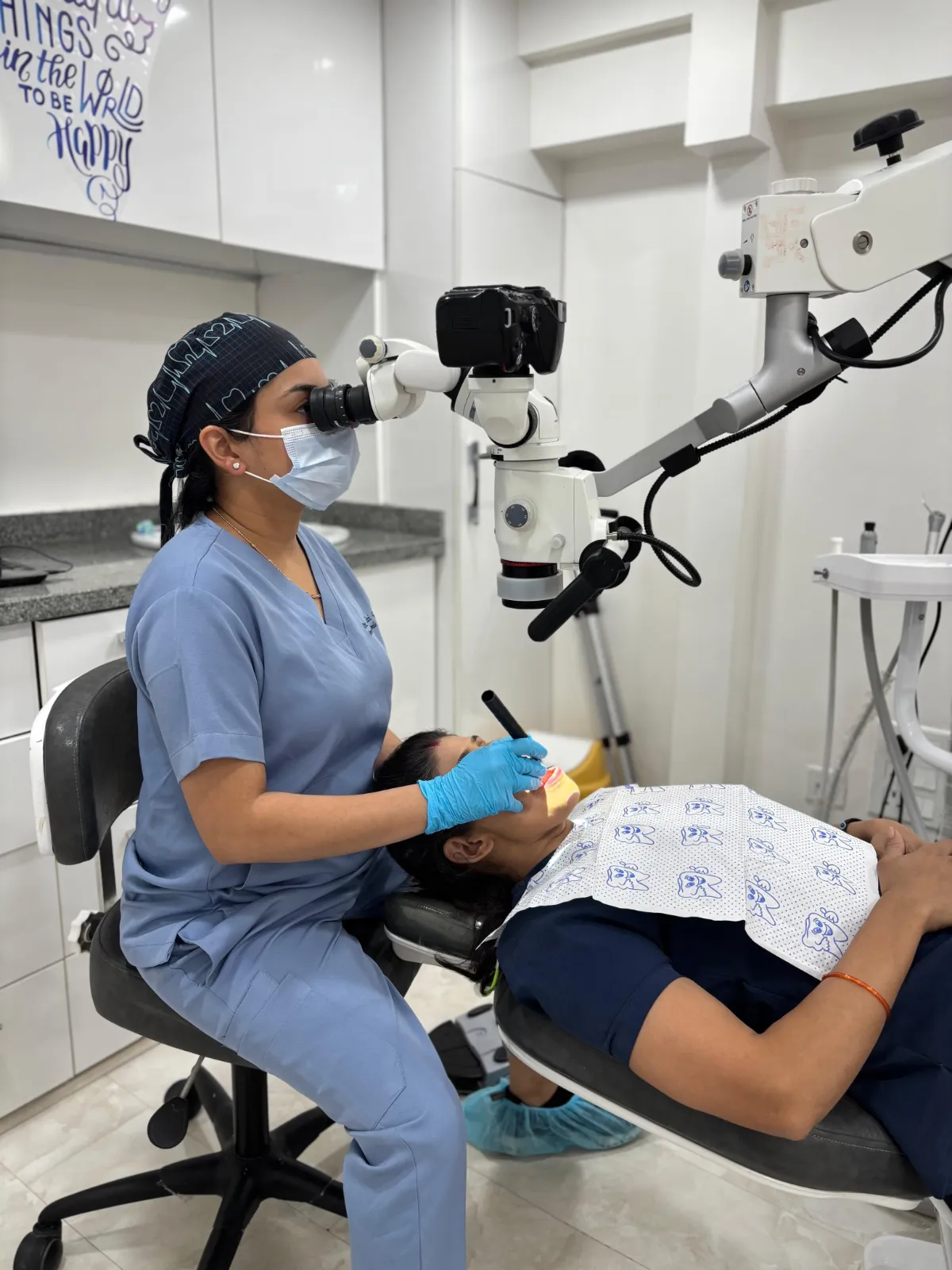
Quick answer: what is root canal treatment and how much does it cost in Gurgaon? Root canal treatment (RCT, often searched as “RTC”) removes infected or inflamed nerve tissue from inside a tooth, cleans and disinfects the canals, and seals them so the tooth can be kept instead of extracted. It is done under local anaesthesia, and most patients say it feels like a long filling. In Gurgaon in 2026, RCT typically costs about ₹3,500–₹6,000 for a front tooth, ₹5,000–₹8,500 for a premolar and ₹7,000–₹12,000 or more for a molar, plus a crown for most back teeth. Many cases are finished in one or two visits. Dentaire Smile Studio, Sector 50, Gurugram · updated October 2026.
Signs you may need a root canal
A tooth needs root canal treatment when the pulp (the nerve and blood vessels inside it) is badly inflamed or infected and can no longer heal on its own. The common signs are:
Lingering pain
Sensitivity to hot or cold that stays for more than 20–30 seconds after the drink is gone, or pain that wakes you at night.
Pain on biting
A sharp or dull ache when you chew on one side, or a tooth that feels “high” or tender to touch.
Swelling or a gum boil
A small pimple on the gum near the tooth, swelling of the face or a bad taste – signs of an abscess.
A darkened tooth
A tooth that has turned grey or bluish after a fall or an old injury, which often means the nerve has died.
Honest note: not every toothache needs a root canal. Early decay or mild, short-lived sensitivity can often be managed with a filling, and some inflamed nerves settle once the cause is removed. A proper examination with an X-ray and vitality tests decides it – and if you do not need an RCT, I will tell you. – Dr. Aditi Goel
Why we do root canals under a microscope
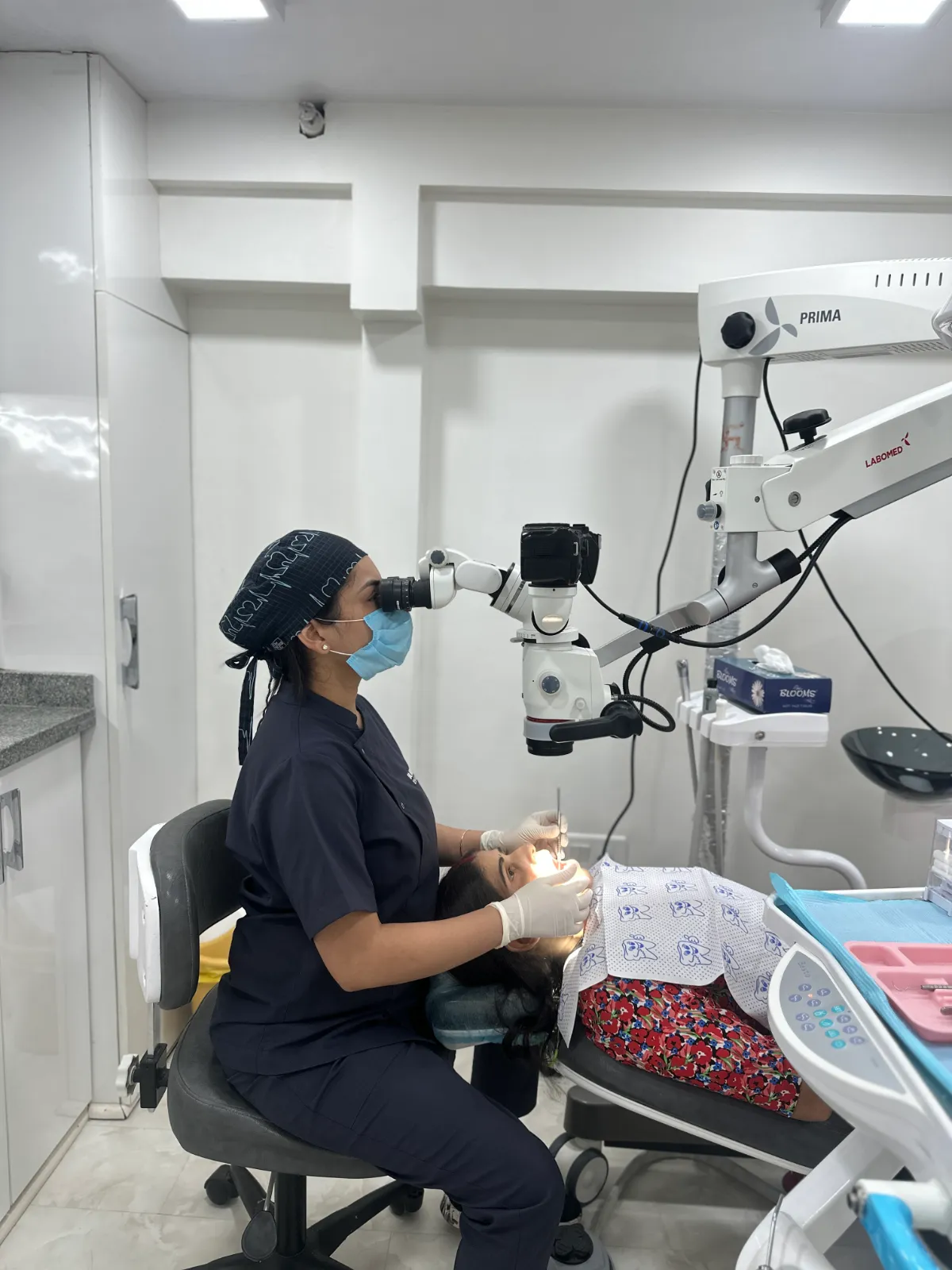
The canals inside a tooth are often narrower than a hair and curved. Most root canals that fail do so because a canal was missed, not cleaned fully, or a crack went unnoticed. A dental operating microscope magnifies and lights the inside of the tooth up to 25 times, so I can work on what I can actually see rather than on feel.
In practice, the microscope helps to:
- Find extra canals – for example the second canal in the mesiobuccal root of upper molars (called MB2), which is easy to miss with the naked eye.
- Spot cracks and fractures early, before you spend money on a tooth that cannot be saved.
- Negotiate narrowed (calcified) canals in older teeth or teeth that had trauma.
- Re-treat old root canals – removing previous filling material and finding what was missed.
- Remove less healthy tooth structure, which keeps the tooth stronger afterwards.
Every root canal is also done with rubber dam isolation (a thin sheet that keeps saliva and bacteria out of the tooth), rotary nickel-titanium files, and digital X-rays.
Your root canal, step by step
- Examination and X-ray. We check the tooth, gums and bite, take a digital X-ray and confirm whether the nerve can be saved. You get a clear plan and a written cost estimate before anything starts.
- Local anaesthesia. The tooth and surrounding area are numbed. If a tooth is very inflamed, we give the anaesthetic time to work fully before beginning.
- Rubber dam. The tooth is isolated so the inside stays clean and nothing can fall into your throat.
- Opening and finding the canals. A small opening is made in the crown of the tooth and every canal is located under the microscope.
- Cleaning and shaping. Infected tissue is removed with rotary files, the working length of each canal is measured, and the canals are rinsed with disinfecting solutions.
- Sealing. The clean canals are filled with a biocompatible material (gutta-percha and sealer) so bacteria cannot re-enter.
- Rebuilding the tooth. The opening is closed with a filling. Back teeth usually need a crown afterwards to protect them from cracking.
Single-sitting or multiple visits?
Many root canals can be completed in a single sitting of about 60–90 minutes. Large reviews of the research, including a Cochrane review, have found that healing is similar whether a root canal is done in one visit or several, so the choice depends on your tooth rather than on a fixed rule.
I usually recommend a single sitting when the tooth is not severely infected and the canals can be cleaned and dried well in one appointment. I recommend two visits when there is active swelling or pus, a large abscess, a re-treatment, or very complex canals – placing a medicine inside the tooth for a week or two gives a better result in those cases.
Root canal treatment cost in Gurgaon (2026)
These are typical ranges in Gurgaon in 2026. Your exact cost depends on the tooth, the number and shape of the canals, and whether it is a first treatment or a re-treatment. It is confirmed after the examination and X-ray, and written down for you before we start – there are no surprise charges midway.
| Treatment | Typical range in Gurgaon | What affects the cost |
|---|---|---|
| RCT – front tooth (incisor or canine) | ₹3,500 – ₹6,000 | Usually one canal; often a single sitting |
| RCT – premolar | ₹5,000 – ₹8,500 | One or two canals |
| RCT – molar | ₹7,000 – ₹12,000+ | Three or four canals, sometimes curved or narrowed |
| Root canal re-treatment | Quoted after X-ray | Removing the old filling and any posts; usually costs more than a first RCT |
| Crown after RCT (if needed) | ₹4,000 – ₹8,000 (PFM) · ₹8,000 – ₹18,000 (zirconia) | Material and how much tooth is left – see our crown cost guide |
A cheaper root canal that misses a canal often ends up costing more – in re-treatment, a crown that has to be redone, or an implant. Ask any clinic how they find all the canals and whether they use rubber dam.
Root canal re-treatment
If a tooth that had a root canal years ago is hurting again, has a gum boil, or shows a dark area at the root tip on an X-ray, it can often be saved with a re-treatment. The old root filling is removed, missed or poorly cleaned canals are found under the microscope, and the tooth is disinfected and sealed again. Re-treatment is one of the areas where a microscope makes the biggest difference. If the tooth has a deep crack or too little healthy structure left, I will tell you honestly and discuss extraction with an implant or bridge instead.
After your root canal
- Mild soreness on biting for two to three days is normal; a regular painkiller is usually enough.
- Avoid chewing hard food on that side until the final filling or crown is in place.
- Get the crown done when advised. In a large long-term study (Ng and colleagues, International Endodontic Journal, 2011), about 95% of root-canal-treated teeth were still in place after four years, and teeth with a permanent crown or cast restoration were lost far less often than teeth left with a temporary filling.
- Brush and floss as usual and keep your six-monthly check-ups, so the tooth and gums stay healthy.
Who will treat you
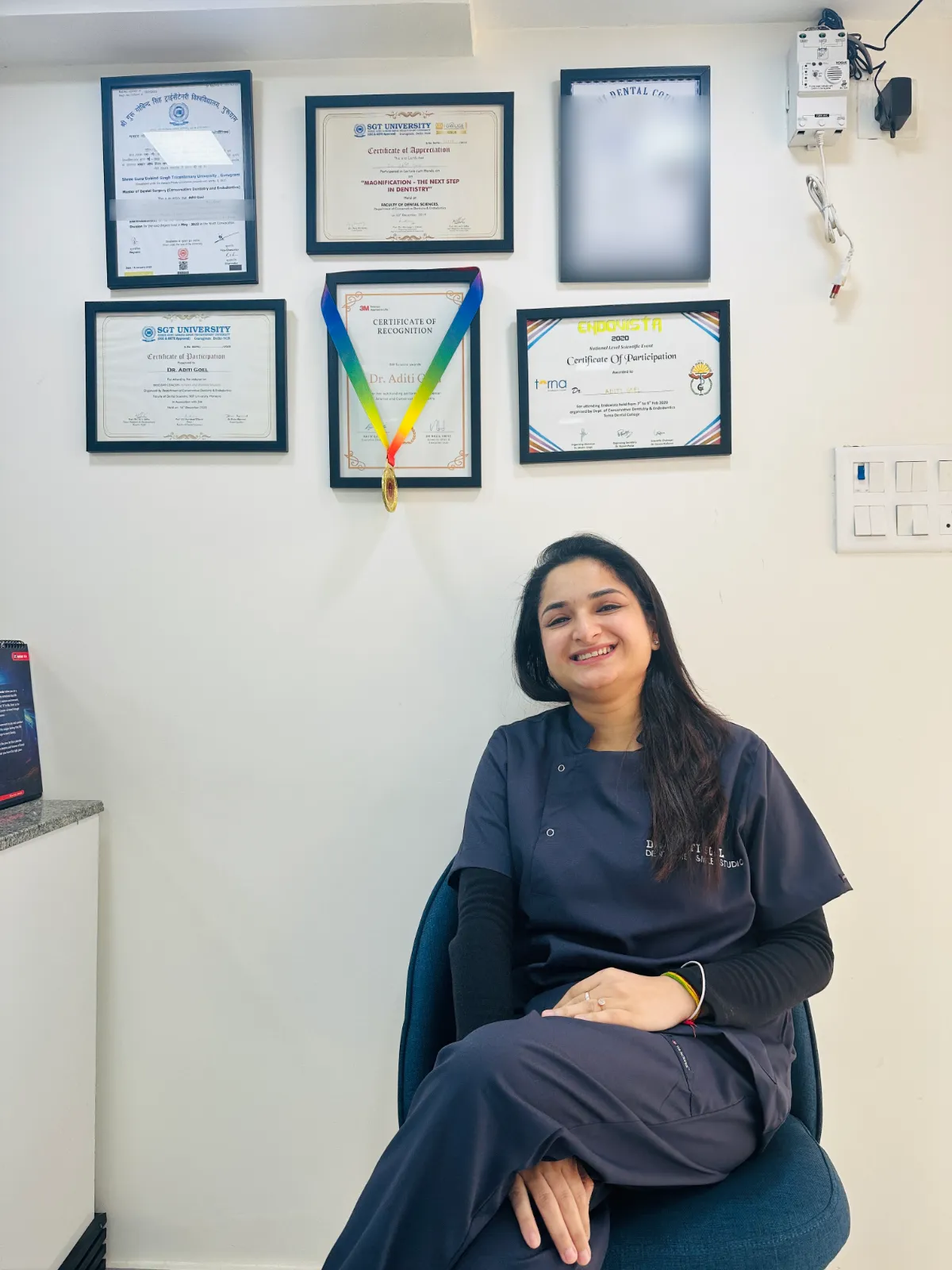
Dr. Aditi Goel, BDS, MDS (Conservative Dentistry & Endodontics)
Dr. Aditi Goel is the founder and lead dentist of Dentaire Smile Studio. Her MDS (Master of Dental Surgery) is in Conservative Dentistry and Endodontics – the speciality devoted to saving natural teeth through root canal treatment and restorations – from SGT University, Gurugram. Microscope-assisted root canal treatment and re-treatment are her main clinical focus.
“My aim is simple: keep your natural tooth whenever it can be kept well, explain every step before I do it, and tell you the cost before we start.”
Read more on root canals
- Is a root canal painful? The honest answer
- Do you really need a crown after a root canal?
- Toothache at night: what to do right now
- Why does a tooth turn blue or grey?
- Crowns and bridges in Gurgaon
- Dental implants, if a tooth cannot be saved
Root canal FAQs
How much does a root canal cost in Gurgaon?
In 2026, root canal treatment in Gurgaon typically costs about ₹3,500–₹6,000 for a front tooth, ₹5,000–₹8,500 for a premolar and ₹7,000–₹12,000 or more for a molar. Most back teeth also need a crown, which costs about ₹4,000–₹8,000 in metal-ceramic or ₹8,000–₹18,000 in zirconia. Your exact cost is confirmed after an examination and X-ray.
Is a root canal painful?
Under modern local anaesthesia, most patients feel pressure and vibration rather than pain, much like a long filling. The tooth may feel sore on biting for two to three days afterwards, which a regular painkiller usually controls. The pain people fear is usually the toothache before treatment – the root canal is what relieves it.
Can a root canal be done in one sitting?
Yes, many root canals are completed in a single sitting of about 60–90 minutes. Research shows healing is similar for single-visit and multiple-visit treatment. Teeth with active swelling, a large abscess, very complex canals or a previous root canal are often better treated in two visits.
Do I need a crown after a root canal?
Most back teeth (premolars and molars) need a crown after a root canal because they take heavy biting forces and are more likely to crack. Front teeth with little damage can often be restored with a filling alone. Long-term studies show root-canal-treated teeth with a permanent crown or cast restoration last longer.
How long does a root canal treated tooth last?
With a good root canal and a proper final restoration, most treated teeth last for many years, often for life. Studies report that roughly 86–93% of root-canal-treated teeth are still in place 2–10 years later, and about 95% at four years in a large study.
What is microscopic root canal treatment, and is it worth it?
Microscopic root canal treatment is a root canal done under a dental operating microscope that magnifies the tooth up to 25 times. It helps the dentist find extra or narrow canals, spot cracks and re-treat old root canals more precisely. It is especially worthwhile for molars, re-treatments and teeth with unusual anatomy.
My old root canal tooth is hurting again. Can it be redone?
Often, yes. Root canal re-treatment removes the old filling material, cleans any missed or re-infected canals under the microscope and seals the tooth again. An X-ray and examination show whether re-treatment is likely to work or whether the tooth has a crack that cannot be repaired.
Is it better to get a root canal or remove the tooth?
If a tooth can be saved with a root canal and crown, keeping it is usually better and less expensive in the long run than extracting it and replacing it with an implant or bridge. Extraction makes sense when the tooth has a vertical crack, too little healthy structure left, or severe gum disease.
What does RTC mean in dental terms?
RTC is a common misspelling of RCT, which stands for root canal treatment – the procedure that removes infected or inflamed nerve tissue from inside a tooth and seals it so the tooth can be kept.
Can I go to work after a root canal?
Yes. Most people go back to work or college the same day. The numbness wears off in two to four hours, so avoid eating on that side until then.
Book a root canal consultation in Sector 50, Gurugram
Dentaire Smile Studio, A127 Nirvana Courtyard Market, Nirvana Country, Sector 50, Gurugram · Monday to Saturday, 10 AM – 7:30 PM
 English
 हिन्दी