
By Dr. Aditi Goel, MDS — Microscopic Endodontics Specialist, Dentaire Smile Studio, Sector 50, Gurugram Published: October 2026 | 10-minute read
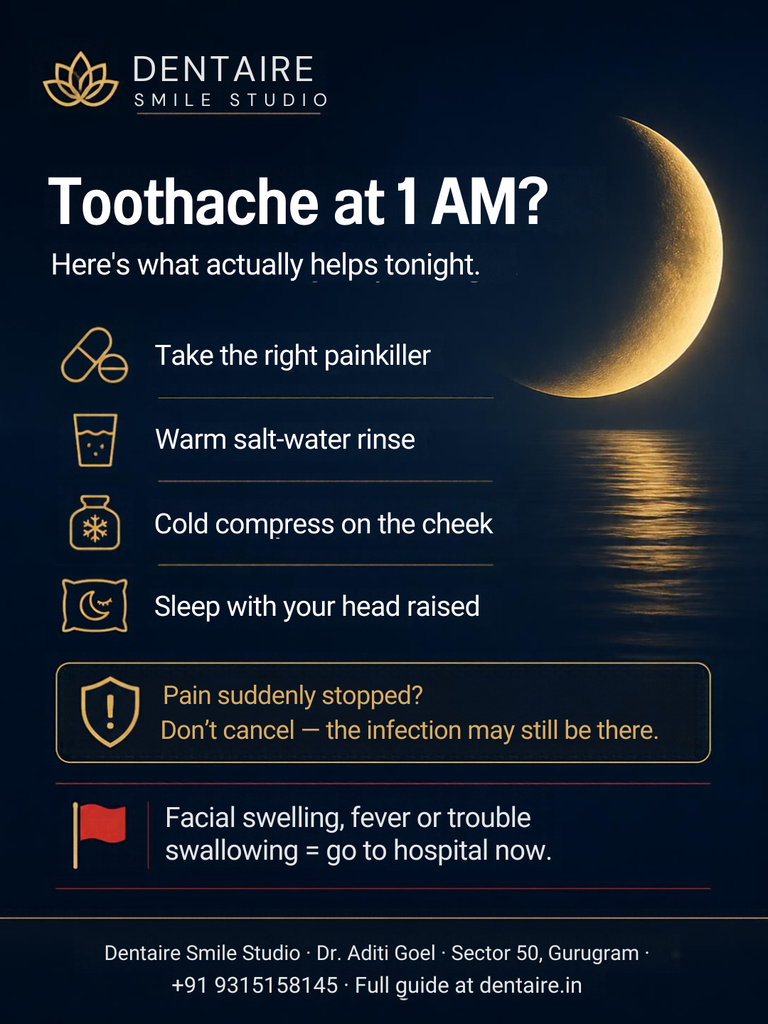
In pain right now? Take a painkiller you can safely use (see the section below), rinse with warm salt water, keep your head raised on an extra pillow, and call us when we open at 10 AM on +91 9315158145. If your face, jaw, or neck is swelling, you have a fever, or you’re struggling to swallow or breathe — skip the rest of this page and go to a hospital emergency department now.
It’s 1 AM. The house is quiet, and the only thing you can hear is the throbbing in your jaw. You’ve already taken a tablet. You’ve tried lying on the other side. You’ve pressed a cold glass against your cheek. And somewhere around the third time you’ve checked the clock, you’ve started searching your phone for anything that might help.
If that’s where you are right now — I’m sorry. Toothache is one of the most miserable kinds of pain there is. Let’s get you through tonight, and then let’s make sure it doesn’t come back.
This guide does two things. First, it gives you the evidence-based steps that genuinely ease tooth pain until you can see a dentist. Second, it helps you understand what your pain is telling you — because a toothache is almost never “just” a toothache. It’s a message, and the sooner it’s read, the simpler the fix.
Why Toothache Gets Worse at Night
If your tooth felt manageable during the day and became unbearable after dark, you’re not imagining it.
When you lie down, more blood flows to your head. That extra pressure pushes on the already inflamed nerve inside the tooth, and the pain intensifies. On top of that, there’s nothing to distract you at night — no work, no conversation, no noise — so your brain focuses entirely on the pain.
This is why one of the simplest things you can do is keep your head raised. Sleep propped up on an extra pillow or two. It genuinely reduces the throbbing.
What Actually Helps Tonight (Ranked by Evidence)
These steps ease the pain. None of them fix the cause — they buy you time until you can be treated.
1. The right painkiller (the most effective step)
For most toothaches, ibuprofen works best, because tooth pain is largely caused by inflammation and ibuprofen reduces inflammation as well as pain. A Cochrane review found that 400 mg of ibuprofen relieved dental pain better than 1,000 mg of paracetamol.
Even better, for adults who can safely take both: ibuprofen and paracetamol together. They work through different mechanisms, and combining them gives stronger relief than either alone — research has found the ibuprofen 400 mg + paracetamol 1,000 mg combination works better than opioid painkillers for dental pain.
Important safety notes:
- Follow the dose on the packet and never exceed the daily limit for either medicine.
- Take ibuprofen with food.
- Don’t take ibuprofen if you have stomach ulcers, kidney disease, certain types of asthma, are on blood thinners, or are pregnant — use paracetamol alone and check with a pharmacist or doctor.
- For children, use only children’s formulations at the dose for their age and weight, and ask a doctor if unsure.
- If you find yourself needing painkillers night after night, that’s a clear sign the problem needs treatment, not more tablets.
2. Clove oil (laung) — the one traditional remedy with real evidence
Clove has been used for tooth pain in Indian homes for generations, and for good reason: it contains eugenol, a natural numbing and antibacterial compound that dentists still use in some temporary fillings today. A systematic review of herbal pain relievers in dentistry found eugenol among the agents with the strongest evidence.
How to use it safely: put a drop of clove oil on a small cotton ball and hold it against the painful tooth for a short while. Keep it off your gums and tongue as much as possible — undiluted clove oil can irritate or burn soft tissue. Chewing a whole clove gently near the tooth is a milder alternative.
3. A warm salt-water rinse
Half a teaspoon of salt in a glass of warm water, swished gently and spat out. It cleans away trapped food, reduces bacteria, and soothes irritated gums. Simple, safe, and you can repeat it several times a day.
4. A cold compress on the outside of your cheek
Wrap ice or a cold pack in a cloth and hold it against your cheek for 15 minutes at a time. Cold reduces swelling and numbs the area. Avoid hot compresses if there’s any swelling — heat can encourage an infection to spread.
5. Gently floss around the tooth
Sometimes the “toothache” is a piece of food wedged between teeth and pressing on the gum. Careful flossing can bring surprising relief.
What NOT to do
- Don’t put an aspirin tablet on your gum. It’s a common home remedy, but aspirin is acidic and causes painful chemical burns to the gum.
- Don’t take antibiotics from the chemist on your own. This is very common in India, and it’s one of the biggest mistakes people make with toothache (more on this below).
- Don’t use hot compresses on a swollen face.
- Don’t chew on the painful side or eat very hot, cold, or sweet foods until it’s treated.
- Don’t ignore it once it calms down — that’s often when the real damage is happening.
Why Antibiotics From the Chemist Won’t Fix Your Toothache
Many people in India walk into a pharmacy, describe their toothache, and walk out with a strip of antibiotics. The pain may ease for a few days. Then it returns — often worse.
Here’s why. Most severe toothaches happen because the nerve inside the tooth (the pulp) is inflamed, dying, or already dead and infected. Antibiotics travel through your blood — but a dead pulp has no blood supply, so the medicine simply can’t reach the source of the infection. It may calm the surrounding swelling temporarily, but the bacteria inside the tooth remain and the infection returns once you stop.
That’s why the UK’s NHS says antibiotics aren’t usually prescribed for a dental abscess unless the infection is spreading or the person is at higher risk — and even then, they go alongside dental treatment, not instead of it.
Self-medicating with antibiotics also contributes to antibiotic resistance, which makes future infections harder to treat. The only real cure for an infected tooth is removing the infection from inside it — usually with a root canal, or sometimes an extraction.
The Most Dangerous Moment: When the Pain Suddenly Stops
This is the single most important thing in this article, so please read it carefully.
If your toothache was severe for days and then suddenly disappears, it usually isn’t good news. It often means the nerve inside the tooth has died. The pain is gone because the nerve can no longer send pain signals — but the infection is still there, and it can quietly spread into your jawbone and beyond.
Pain often returns later, as pressure builds up at the tip of the root — this time as an abscess. What could have been a straightforward root canal becomes a more complicated case, sometimes involving bone loss or losing the tooth altogether.
If your toothache went away on its own, still get it checked. A simple X-ray will show whether the tooth is healthy or whether an infection is silently developing.
What Is Your Toothache Telling You?
Different kinds of pain point to different causes. This isn’t a diagnosis — only an examination and X-ray can tell for certain — but it helps you describe your pain and understand how urgent it is.
| What you feel | What it often means | How urgent |
|---|---|---|
| Brief, sharp twinge with cold or sweets that fades within seconds | Sensitivity, exposed root, or an early cavity | Book a routine visit soon |
| Pain with hot or cold that lingers for a minute or more | The nerve is inflamed (pulpitis) — often needs a root canal | See a dentist within a few days |
| Throbbing pain that wakes you, worse lying down | Advanced inflammation or infection | See a dentist as soon as possible |
| Tooth hurts when you bite down or tap it; may feel “taller” | Infection at the root tip (abscess) or a cracked tooth | See a dentist as soon as possible |
| Sharp pain when biting that stops when you release | Cracked tooth | See a dentist soon — cracks can spread |
| Swollen gum at the very back with pain opening your mouth | Infected wisdom tooth (pericoronitis) | See a dentist within a day or two |
| A pimple-like bump on the gum, bad taste in the mouth | Abscess draining through the gum | See a dentist soon — the infection is active |
| Several upper back teeth ache together during a cold or sinus problem | Sinus pressure, not the teeth | See a doctor if it persists |
| Swelling spreading to your face, eye, jaw, or neck, with fever | Spreading infection | Emergency — go to hospital now |
When a Toothache Is a Medical Emergency
Most toothaches are urgent but not dangerous. A few signs mean the infection may be spreading beyond the tooth — and that needs hospital care immediately, day or night:
- Swelling of the face, jaw, or neck that is spreading, or swelling near your eye
- Difficulty swallowing or breathing
- A high fever with tooth pain
- Feeling generally very unwell, faint, or confused
- Bleeding from the mouth that won’t stop after 20 minutes of firm pressure
- A facial injury or blow to the jaw
If you have any of these, don’t wait for the clinic to open. Go to the nearest hospital emergency department. The hospital can control the infection and stabilise you; your dentist will then treat the tooth itself.
What Happens When You See a Dentist
The good news is that once you’re in the chair, relief is usually fast. At your visit, we will:
- Find the exact cause. A clinical examination and an X-ray pinpoint which tooth is responsible and why. This matters — the painful tooth isn’t always the one you think it is.
- Get you out of pain. In many cases, pain relief starts that same visit — for example, by cleaning out the inflamed or infected nerve, draining an abscess, or placing a soothing temporary filling.
- Treat it properly. Depending on the cause, that might be a filling, a root canal, treatment for a cracked tooth, gum treatment, or — when a tooth can’t be saved — an extraction.
At Dentaire Smile Studio, we treat painful teeth under a dental operating microscope, which magnifies the tooth up to 25 times. For root canal treatment in particular, that precision helps us find and clean every canal — including tiny or hidden ones that are a common reason root canals fail. Modern anaesthesia means the treatment itself is comfortable; most people are surprised at how much better they feel afterwards.
If you’re nervous about the treatment, read our guide on whether a root canal is painful — the honest answer is very reassuring.
How to Avoid the Next 1 AM Toothache
Almost every severe toothache starts as something small and painless months earlier — a tiny cavity, a small crack, a bit of gum inflammation. Catching those early is how you avoid the night you’ve just had.
- Get a check-up every six months, even when nothing hurts. Small cavities are quick, comfortable fillings. Big ones become root canals.
- Brush twice a day with fluoride toothpaste, and clean between your teeth daily.
- Don’t ignore sensitivity. A tooth that’s started reacting to cold is often an early warning.
- Wear a night guard if you grind your teeth — grinding causes cracks that can lead to sudden, severe pain.
- Limit how often you have sugary snacks and drinks. It’s the frequency, not just the amount, that drives decay.
Frequently Asked Questions About Toothache
Q: How can I stop a toothache fast at night? A: For most adults, the fastest relief comes from an anti-inflammatory painkiller like ibuprofen (or ibuprofen and paracetamol together, if you can safely take both), combined with a warm salt-water rinse, a cold compress on the outside of the cheek, and sleeping with your head raised. Clove oil on a cotton ball against the tooth can add some numbing. These steps ease pain temporarily — the tooth still needs to be seen by a dentist.
Q: Which painkiller is best for toothache? A: Ibuprofen is usually most effective because toothache is mainly inflammatory, and a Cochrane review found 400 mg of ibuprofen relieved dental pain better than 1,000 mg of paracetamol. Taking ibuprofen and paracetamol together gives even stronger relief for adults who can safely use both. Use paracetamol alone if ibuprofen isn’t suitable for you (for example, with stomach ulcers, kidney problems, some types of asthma, blood thinners, or pregnancy), and always follow the dose on the packet.
Q: Does clove oil really work for toothache? A: Yes, for temporary relief. Clove oil contains eugenol, a natural compound with genuine numbing and antibacterial effects that dentists still use in some temporary fillings. Apply a drop on a cotton ball to the painful tooth, keeping it off the gums, as undiluted clove oil can irritate soft tissue. It doesn’t treat the cause of the pain.
Q: Should I take antibiotics for a toothache? A: Not on your own. Most severe toothaches come from an inflamed or dead nerve inside the tooth, and antibiotics can’t reach a dead pulp because it has no blood supply. They may reduce swelling briefly, but the infection returns once you stop. Antibiotics are only needed when an infection is spreading, and even then they’re used alongside dental treatment, not instead of it. Self-medicating also contributes to antibiotic resistance.
Q: My toothache suddenly stopped. Is the problem gone? A: Often not. A severe toothache that suddenly disappears frequently means the nerve inside the tooth has died. The pain stops because the nerve can no longer send signals, but the infection can remain and spread into the jawbone, often returning later as an abscess. Get the tooth checked with an X-ray even if it no longer hurts.
Q: When is a toothache an emergency? A: Go to a hospital emergency department immediately if you have spreading swelling of the face, jaw, or neck, swelling near the eye, difficulty swallowing or breathing, a high fever with tooth pain, uncontrolled bleeding, or a jaw injury. These can be signs of a spreading infection that needs urgent care. For tooth pain without these signs, see a dentist as soon as possible.
Q: Why does my toothache get worse when I lie down? A: When you lie flat, more blood flows to your head, which increases pressure on the inflamed nerve inside the tooth and makes the throbbing worse. There are also fewer distractions at night, so you notice the pain more. Sleeping with your head propped up on extra pillows helps.
Q: Can I put aspirin on my gum for tooth pain? A: No. Placing an aspirin tablet against the gum is a common home remedy, but aspirin is acidic and causes painful chemical burns to the gum tissue. If you use a painkiller, swallow it as directed on the packet.
Q: What does a dentist do for a toothache? A: The dentist examines the tooth and takes an X-ray to find the exact cause, then relieves the pain — often in the same visit — by cleaning out an inflamed or infected nerve, draining an abscess, or placing a temporary filling. Definitive treatment depends on the cause and may include a filling, a root canal, gum treatment, or an extraction if the tooth can’t be saved.
Q: Will I need a root canal if my tooth hurts? A: Not necessarily. A brief twinge with cold may just be sensitivity or a small cavity needing a simple filling. Pain that lingers after hot or cold, throbbing pain that wakes you, or pain when biting often means the nerve is inflamed or infected, which usually does need a root canal to save the tooth. Only an examination and X-ray can tell for certain.
The Bottom Line
Tonight, the goal is simple: get some relief and some sleep. The right painkiller, a salt-water rinse, a cold compress, a little clove oil, and an extra pillow will help most people get through to morning.
But please don’t let tomorrow’s relief fool you. A toothache is your tooth telling you something has gone wrong inside it — and whether the pain fades or not, that problem is still there. Treated early, it’s usually quick, comfortable, and straightforward. Left alone, it rarely goes away, and it tends to come back at the worst possible moment.
If you’re in pain, call us when we open. Tell the team you have a toothache, and we’ll do our best to see you as soon as we can.
Dentaire Smile Studio is at A127, Nirvana Courtyard Market, Nirvana Country, Sector 50, Gurugram. Open Monday – Saturday, 10 AM – 7:30 PM. 📞 +91 9315158145 | 🌐 dentaire.in
Dr. Aditi Goel is a Microscopic Endodontics Specialist and the founder of Dentaire Smile Studio, Gurgaon. She specialises in saving painful and infected teeth with precise, microscope-assisted root canal treatment, and provides comprehensive dental care for patients across Gurgaon and Delhi NCR.
This article is for general information and doesn’t replace an examination by a dentist. If you have signs of a spreading infection, seek emergency medical care immediately.
Related Reading:
- Is a Root Canal Painful? The Truth Most Dentists Don’t Tell You
- Wisdom Tooth Pain in Gurgaon: When to Remove It, When to Leave It
- Why Are My Teeth So Sensitive? A Gurgaon Dentist’s Complete Guide
- “I’m Scared of the Dentist”: An Honest Guide to Dental Anxiety
- Your Bleeding Gums Are Trying to Tell You Something About Your Heart
— SEO & PUBLISHING NOTES —
Meta Title: Toothache at Night? What to Do Now & When It’s an Emergency | Dentaire Gurgaon Meta Description: Severe toothache? A Gurgaon root canal specialist explains what actually eases tooth pain tonight, why chemist antibiotics don’t fix it, and which signs mean emergency. Slug: toothache-relief-what-to-do-gurgaon Primary Keywords: toothache relief, toothache at night, tooth pain what to do, toothache dentist Gurgaon, emergency dentist Gurgaon, severe tooth pain Secondary Keywords: best painkiller for toothache, clove oil for toothache, antibiotics for toothache, toothache suddenly stopped, tooth pain when biting, when is toothache an emergency, toothache worse lying down, tooth abscess symptoms Schema: Article + FAQPage (all 10 Q&As) Author: Dr. Aditi Goel, MDS Category: Emergency Dental Care, Root Canal, Patient Guide Word count: ~2,500 words Internal links: Link from Root Canal, Wisdom Tooth, and Sensitive Teeth blogs; link TO Root Canal blog and Contact page. Add a sticky “Call now” button at the top on mobile. Featured image suggestion: Calm, non-graphic image — a person holding their cheek in soft lighting, or navy + white typography “Toothache tonight? Here’s what helps.” Avoid drills, blood, or clinical close-ups. Google Ads note: Strong candidate as the final URL for the “Toothache” ad group in the new Search campaign. The urgent-help box at the top and tap-to-call number serve ad visitors well. Review in Google Ads after 2–3 weeks: if the contact page converts better, switch back. LLM note: High-volume urgent queries — “how to stop toothache at night,” “best painkiller for toothache,” “does clove oil work for toothache,” “should I take antibiotics for toothache,” “my toothache suddenly stopped,” “when is toothache an emergency,” “why is toothache worse when lying down,” “can I put aspirin on my tooth.” All 10 FAQs open with a direct one-sentence answer for AI extraction. Compliance note: No superiority claims (DCI). Medication guidance is general, defers to packet dosing and pharmacists, and includes contraindications — keep it that way in any edits.
 English
  हिन्दी