
By Dr. Aditi Goel, MDS — Conservative Dentistry Expert, Dentaire Smile Studio, Sector 50, Gurugram
Published: October 2026 | 11-minute read
You went in for a check-up because a back tooth felt a little sharp when you bit into a roti. Twenty minutes later you’re holding a treatment plan: “Crown — zirconia — ₹15,000.” The dentist sounded sure. But driving home on Golf Course Extension Road, the question won’t go away: Did that tooth really need a crown? And why does the clinic across the road quote half that?
You’re not alone in asking. “Do I really need a crown?” is one of the most common questions I hear, usually from patients who already have a quote from somewhere else. It’s a good question, and it deserves an honest answer.
What a crown actually is (and what it costs your tooth)
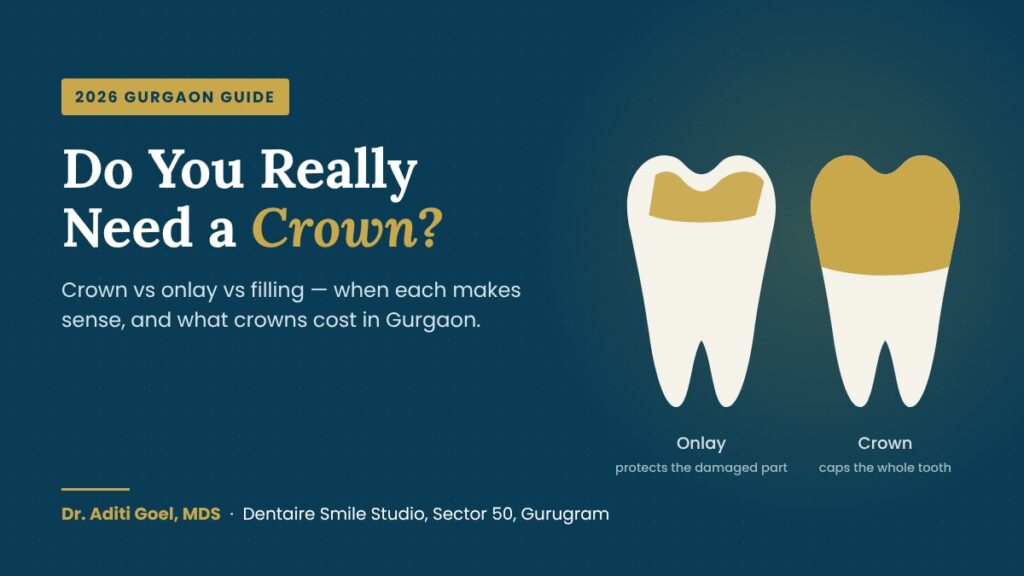
A crown is a cap that covers the whole visible part of a tooth. To fit it, the dentist trims the tooth down on every side so the crown can sit over it like a thimble.
That trimming is the part most people never hear about. A widely cited study by Edelhoff and Sorensen in the Journal of Prosthetic Dentistry found that a full crown preparation removes roughly 63–72% of the visible tooth structure. Once that enamel is gone, it doesn’t grow back. The tooth will need a crown, and eventually a replacement crown, for the rest of its life.
That doesn’t make crowns bad. A well-made crown on the right tooth can protect it for decades. It just means a crown should be a decision, not a default.
The principle I go by is simple:
Keep as much of your natural tooth as you safely can. Cover only what needs protecting.
When a crown genuinely is the right choice
In my practice, these are the situations where I recommend a crown without hesitation:
1. A back tooth after root canal treatment, with significant structure lost. This is the big one. After a root canal, a molar or premolar is weaker and more likely to crack under chewing forces. A classic study of 203 root-canal-treated teeth (Aquilino and Caplan, 2002) found that teeth left without a crown were lost at about six times the rate of crowned teeth. If you’ve had a root canal on a back tooth, the question is usually what kind of protection it needs, not whether it needs any.
2. A cracked tooth. If a crack runs through the tooth but hasn’t reached the root, a crown can hold the pieces together and stop the crack from spreading. Under the dental microscope we use at Dentaire, I can see fine crack lines that are easy to miss with the naked eye, which helps decide whether a crown will save the tooth or not.
3. A tooth that is more filling than tooth. When a large old filling has broken down and very little natural tooth is left around it, another big filling often fails. A crown spreads the biting load more safely.
4. Severe wear from grinding (bruxism). If you grind at night, your teeth take enormous force. In the 2025 trial I mention below, grinding was the single strongest predictor of a restoration failing.
5. Replacing a missing tooth with a bridge. A bridge uses crowns on the neighbouring teeth as anchors. (Whether a bridge or an implant is better for you is a separate conversation. I’ve covered it in my dental implants guide.)
When you may NOT need a full crown
This is where honest dentistry matters most. These are the cases where I often suggest something smaller:
A root-canal-treated molar that is still largely intact. A 2025 randomised clinical trial in the Journal of Dentistry followed root-canal-treated molars with minimal tooth loss for three years. Molars restored with a well-done composite filling survived at 76.7%, compared with 93.3% for molars that also got a crown. The difference was not statistically significant. The authors still found crowns more predictable, especially for people who grind their teeth, but a direct filling was a reasonable option for some patients. The takeaway: for a mostly intact tooth, a crown is not automatically the only answer.
A large cavity or broken cusp where the rest of the tooth is healthy. Here an onlay is often the better option. An onlay is a custom-made piece of ceramic that replaces only the damaged part of the biting surface, including one or more cusps, and is bonded onto the tooth. It protects the weak areas without trimming the whole tooth down on all sides.
A front tooth that’s just discoloured or chipped. Whitening, bonding or a veneer usually preserves far more tooth than a crown. I explain those options in my veneers guide.
A tooth that’s only sensitive. Sensitivity alone is almost never a reason for a crown. Start with the causes. Here’s my guide to sensitive teeth.
If you’ve been advised a crown, it’s completely fair to ask: “Could this tooth be restored with an onlay or a filling instead? Why not?” A good dentist will explain the reasoning, not get defensive.
Crown vs onlay vs filling: an honest comparison
| Large filling (composite) | Onlay (ceramic) | Full crown | |
|---|---|---|---|
| Tooth structure removed | ✅ Least | ✅ Moderate — only damaged areas | ⚠️ Most (≈63–72%) |
| Protects weak cusps | ⚠️ Limited | ✅ Yes | ✅ Yes |
| Best for | Small-to-medium damage | Large damage, healthy remaining walls | Badly broken, cracked or heavily filled teeth |
| Strength under heavy biting / grinding | ⚠️ Lower | ✅ Good | ✅ Very good |
| Number of visits | ✅ Usually one | ⚠️ Usually two | ⚠️ Usually two |
| Cost | ✅ Lowest | ⚠️ Medium–high | ⚠️ Medium–high |
| Future options if it fails | ✅ Onlay or crown still possible | ✅ Crown still possible | ⚠️ Replacement crown, then fewer options |
| Appearance | ✅ Tooth-coloured | ✅ Tooth-coloured | ✅ Tooth-coloured (ceramic) / ⚠️ grey line possible (PFM) |
Which crown material? Zirconia vs E-max vs PFM vs metal
If a crown is the right call, the next question is material. Here’s how I explain it in the chair:
- Metal crowns are very strong and need the least trimming, but they’re visibly metallic. Fine for a back tooth no one sees, if appearance doesn’t matter to you.
- PFM (porcelain-fused-to-metal) has a metal base with tooth-coloured porcelain on top. It has a long track record and is affordable. Over time a thin grey line can show at the gum, and the porcelain can chip.
- Zirconia is a very strong, metal-free ceramic. It’s a popular choice for molars and for people who grind. Five-year studies comparing zirconia and PFM crowns on back teeth found no meaningful difference in survival, so the choice often comes down to appearance and budget.
- E-max (lithium disilicate) is the most natural-looking option, with lifelike translucency. It’s ideal for front teeth and visible premolars, and it’s also used for onlays.
There is no single “best” material. The right one depends on which tooth it is, how much you grind, how much it shows when you smile, and your budget.
What do crowns cost in Gurgaon in 2026?
These are typical per-tooth ranges you’ll see across Gurgaon clinics in 2026. Prices vary with the lab, the brand of material, and how much work the tooth needs first.
| Type | Typical range in Gurgaon (per tooth) |
|---|---|
| Metal crown | ₹2,000 – ₹4,000 |
| PFM (porcelain-fused-to-metal) | ₹4,000 – ₹8,000 |
| Zirconia | ₹8,000 – ₹18,000 (premium monolithic up to about ₹25,000) |
| E-max (lithium disilicate) | ₹12,000 – ₹20,000 |
| Ceramic onlay | Usually close to an E-max crown, as the same material and lab are used |
| Bridge | Priced per unit — a 3-unit bridge costs roughly three crowns |
For reference, one large Gurgaon dental chain listed starting prices in March 2026 of about ₹4,690 for PFM, ₹9,490 for zirconia and ₹13,990 for E-max.
What a complete quote should include: tooth preparation, impressions or a digital scan, a temporary crown, the lab fee for the final crown, cementation, and a bite check afterwards. Ask whether the quote covers any core build-up (rebuilding the tooth before the crown) or a post after root canal treatment, because these are often extra.
Be careful with very low quotes. A crown that’s poorly fitted at the edges lets bacteria seep underneath, and decay under a crown is often found late. The fit at the margin matters more than the brand name on the box.
Why crowns are so common in India (and what you can do about it)
Two patterns I see again and again in Gurgaon:
We wait too long. Many of us only see a dentist when something hurts. By the time a cavity hurts, it’s often deep, and a small filling has turned into a root canal and a crown. A check-up every six months is the cheapest way to avoid crowns altogether.
Old silver fillings and hard foods. Many adults have large amalgam fillings from decades ago. Combine those with chewing hard foods like supari, chikki or ice, and the walls of the tooth around the filling eventually crack. If you have big old fillings, it’s worth having them checked before a cusp breaks off.
What to do if you’ve been told you need a crown
- Ask why. What specific problem is the crown solving: a crack, a root canal, a broken cusp, a failing filling?
- Ask about alternatives. Would an onlay or filling work? If not, why not?
- Ask to see it. An X-ray or an intraoral photo of your tooth should make the reason clear.
- Ask what the quote includes. Build-up, post, temporary crown, and follow-up visits.
- Ask about material. Why this material for this tooth?
- If the tooth has had a root canal, don’t delay protection. A temporary filling is not designed to last. Teeth that crack after root canal treatment are sometimes impossible to save.
- Look after the crown. Brush and floss around the gum line. A crowned tooth can still get decay at the edge.
Frequently Asked Questions
Q: Do I need a crown after a root canal?
A: Usually, for back teeth. Root-canal-treated molars and premolars are more likely to crack, and studies show they’re lost much more often without full-coverage protection. If the tooth is still largely intact, an onlay or a strong bonded filling can sometimes be enough. Front teeth with little structure lost often don’t need a crown.
Q: How much does a dental crown cost in Gurgaon?
A: In 2026, typical ranges are ₹4,000–₹8,000 for PFM, ₹8,000–₹18,000 for zirconia and ₹12,000–₹20,000 for E-max per tooth. The final cost depends on the lab, material and any build-up work needed.
Q: Is zirconia or E-max better?
A: Zirconia is stronger and often chosen for molars and people who grind. E-max looks more natural and is ideal for front and visible teeth. Both are good materials. The right one depends on the tooth and your bite.
Q: Is getting a crown painful?
A: The preparation is done under local anaesthesia, so most people feel only pressure and vibration. Some teeth feel mildly sensitive for a few days afterwards.
Q: How long does a dental crown last?
A: A well-made crown commonly lasts 10–15 years, and many last longer with good brushing, flossing and regular check-ups. Grinding, decay at the edges and poor fit shorten its life.
Q: What’s the difference between an onlay and a crown?
A: An onlay replaces only the damaged part of the biting surface and is bonded onto the tooth. A crown covers the whole tooth, which means trimming it on all sides. An onlay keeps more of your natural tooth.
Q: Can a crown be done in one day?
A: Some clinics with in-house milling can make crowns the same day. Most crowns, including at lab-based clinics, take two visits about a week apart, with a temporary crown in between.
Q: Can I get a crown on a tooth that has a cavity?
A: The decay must be removed first and the tooth rebuilt if needed. A crown placed over active decay will fail.
Q: Why did my old crown turn black at the gum line?
A: That grey or dark line is usually the metal base of a PFM crown showing as the gum recedes. It’s cosmetic, but it’s worth checking that there’s no decay at the edge.
Q: Should I get a second opinion before a crown?
A: If you’re unsure, yes. A crown is irreversible. A good dentist won’t mind you asking, and will show you why the tooth needs it.
The bottom line
A crown is one of the most useful tools in dentistry. It can save a cracked tooth or protect a root-canal-treated molar for decades. But it’s also one of the most over-prescribed. Before you agree to one, make sure you understand what problem it’s solving, and whether something smaller would do the job.
If you’d like a second opinion on a crown you’ve been advised, or you have a tooth that’s cracked, broken or recently had a root canal, I’m happy to take a look. I’ll show you what I see and explain every option, including the ones that cost less.
Dentaire Smile Studio is at A127, Nirvana Courtyard Market, Nirvana Country, Sector 50, Gurugram.
Open Monday – Saturday, 10 AM – 7:30 PM.
📞 +91 9315158145 | 🌐 dentaire.in
Dr. Aditi Goel (MDS) is a microscopic endodontics specialist and conservative dentist, and the founder of Dentaire Smile Studio in Sector 50, Gurugram. She focuses on saving natural teeth wherever possible.
 English
 हिन्दी