
By Dr. Aditi Goel, MDS — Cosmetic Dentist, Dentaire Smile Studio, Sector 50, Gurugram Published: July 2026 | 12-minute read
You’ve finally decided to fix your teeth. Maybe it’s the crowding that’s bothered you since school. Maybe it’s a gap, or teeth that have slowly shifted with age. Either way, you’ve made the decision — and now you’re stuck on the next one.
Invisalign, or braces?
The internet has a strong opinion. Every aligner ad makes braces look medieval. Every orthodontist who loves brackets warns you about “aligner compliance.” And somewhere in the middle is the honest answer for your teeth — which depends on factors most comparison articles never mention.
Let me give you that honest answer. As someone who treats both, I have no stake in pushing you toward one or the other — only in getting you the straight teeth you want, in the way that actually suits your case, your lifestyle, and your budget.
The Fundamental Difference
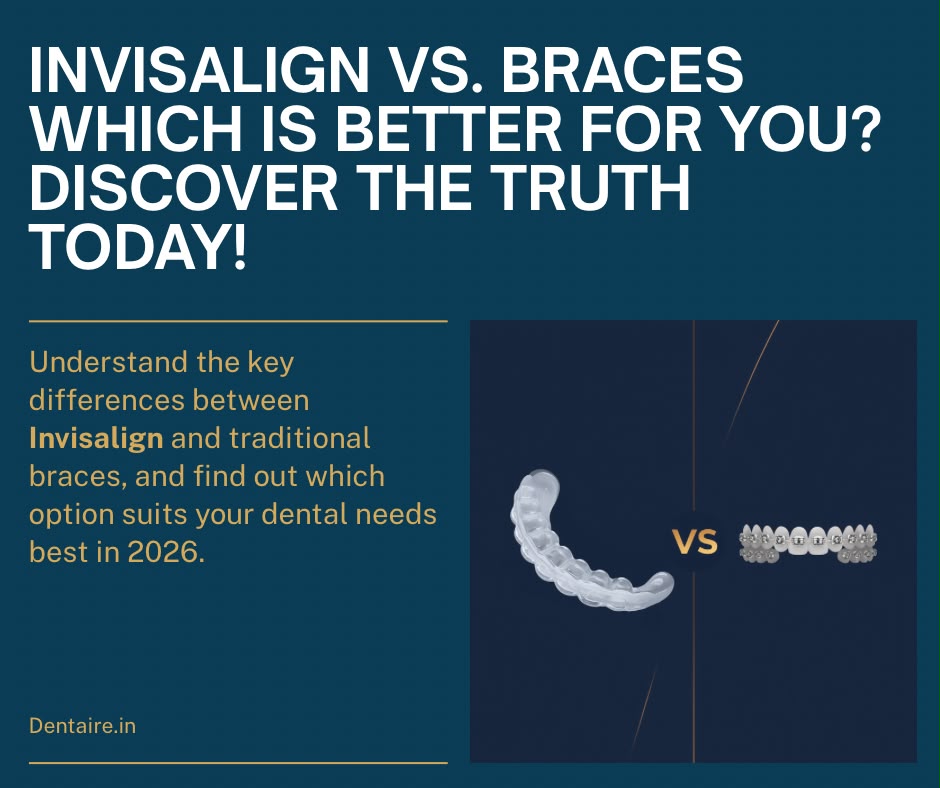
Traditional braces use metal or ceramic brackets bonded to each tooth, connected by an archwire that is periodically tightened. They apply continuous, three-dimensional force around the clock. They are fixed in place and can only be removed by your dentist.
Clear aligners (Invisalign and others) are a series of custom-made, transparent, removable trays — made from smooth medical-grade plastic — that you change every one to two weeks as your teeth gradually shift into position. Small tooth-coloured “attachments” are often bonded to certain teeth to give the trays grip for more complex movements.
Both straighten teeth. Both correct bite problems. Both are proven and effective. But they do not perform equally across every type of case — and that distinction matters far more than most comparison articles admit.
The Honest Comparison Table
| Clear Aligners (Invisalign) | Metal Braces | Ceramic Braces | |
|---|---|---|---|
| Visibility | ✅ Nearly invisible | ❌ Very visible | ⚠️ Tooth-coloured, subtle |
| Removable | ✅ Yes (for eating/cleaning) | ❌ Fixed | ❌ Fixed |
| Food restrictions | ✅ None (removed to eat) | ❌ Many (no hard/sticky foods) | ❌ Many |
| Best for complex cases | ⚠️ Limited | ✅ Excellent | ✅ Excellent |
| Cleaning/hygiene | ✅ Brush & floss normally | ⚠️ Harder to clean | ⚠️ Harder to clean |
| Comfort | ✅ Smooth plastic | ⚠️ Can irritate cheeks/lips | ⚠️ Can irritate |
| Depends on compliance | ❌ Must wear 20–22 hrs/day | ✅ Always working | ✅ Always working |
| Clinic visits | ✅ Fewer | ⚠️ Regular tightening | ⚠️ Regular tightening |
| Treatment time | 6–18 months (mild–moderate) | 18–24+ months | 18–24+ months |
| Cost (Gurgaon 2026) | ₹80,000 – ₹2,50,000+ | ₹25,000 – ₹60,000 | ₹40,000 – ₹80,000 |
Cost in Gurgaon (2026): The Real Numbers
This is usually the deciding factor, so let’s be specific.
Metal braces remain the most affordable orthodontic option. In Gurgaon in 2026, a full course typically ranges from ₹25,000 to ₹60,000, depending on case complexity and whether extractions are needed.
Ceramic braces (tooth-coloured, less visible) generally cost slightly more — typically ₹40,000 to ₹80,000 for a full treatment.
स्पष्ट संरेखक vary widely by brand and complexity:
- Premium Indian brands (e.g. Flash, Toothsi, makeO): ₹60,000 – ₹1,50,000
- Invisalign (premium global brand): ₹1,25,000 – ₹2,50,000+, and up to ₹3–4 lakh for very complex full-arch cases
Why the wide range? The cost depends on how many aligners you need (mild cases need fewer), the severity of misalignment, the brand, and the experience of the treating dentist. A short “Invisalign Lite” or mild-case aligner treatment costs far less than a full complex correction.
On EMI: Most reputable clinics, including ours, offer no-cost EMI options — commonly ₹5,000–₹7,000 per month — which makes aligners far more accessible for students and working professionals than the lump-sum figure suggests.
The honest takeaway on cost: Braces give you the most correction for the least money. Aligners cost more — you’re paying for invisibility, removability, and convenience. Whether that premium is worth it depends entirely on how much those three things matter to your life.
When Clear Aligners Are the Better Choice
Aligners genuinely shine for many patients. They’re the better option when:
✅ Your case is mild to moderate — crowding, spacing, or mild bite issues. This covers a large majority of adult patients.
✅ Appearance matters to you — if you’re a working professional, in a client-facing role, getting married, or simply don’t want a “metal mouth” for two years, the near-invisibility is a genuine quality-of-life advantage.
✅ You want dietary freedom — you remove them to eat. No giving up your favourite foods, no worrying about brackets during a wedding buffet.
✅ You value easy hygiene — you brush and floss completely normally, which braces make much harder. This lowers the risk of decay and gum problems during treatment.
✅ You’re disciplined — and this is the crucial one. Aligners only work if you wear them 20–22 hours a day. If you’re the kind of person who will actually keep them in, they’re excellent. If you know they’ll end up sitting in a drawer, they won’t work — and braces are the honest recommendation.
When Braces Are the Better Choice (Yes, Sometimes They Genuinely Are)
This is the section aligner marketing never shows you. For certain cases, fixed braces are simply more precise and reliable — and recommending aligners anyway would be doing you a disservice.
Braces are generally the better choice when:
✅ Your case is complex — severely rotated teeth, large gaps, significant crowding, or serious bite problems. Braces apply constant three-dimensional force and give the orthodontist precise control that aligners can’t always match.
✅ You need major tooth movements — cases involving extractions, significant realignment, or teeth that need to be moved long distances. Fixed appliances do the “heavy lifting” more predictably.
✅ Compliance is a concern — braces work 24/7 whether you think about them or not. There’s no “did I wear them enough today?” variable. For teenagers, or adults who know themselves to be forgetful, this reliability is a real advantage.
✅ Budget is the priority — braces deliver excellent, proven results for a fraction of the aligner cost.
Sometimes the best answer is a hybrid: starting with a short course of braces to achieve major movements, then finishing with aligners for refinement — combining the power of brackets with the discretion of clear trays. An honest assessment tells you if that’s the smart path for your case.
The Compliance Factor — The Most Important Thing Nobody Tells You
Here’s the single most important point in this entire article: aligners only work if you wear them.
The recommended wear time is 20–22 hours a day. That means they come out only for eating, drinking anything other than water, and brushing. Every hour beyond that which they spend out of your mouth slows your treatment down.
I’ve seen patients whose aligner treatment stretched from a planned 12 months to nearly 24 — not because anything went wrong clinically, but because the trays kept ending up on the bedside table. I’ve also seen patients who were perfectly disciplined and finished ahead of schedule.
This is why an honest consultation asks an uncomfortable question: realistically, will you wear them? If the honest answer is no, braces — which work whether you remember them or not — will get you a better result. There’s no shame in that. Knowing yourself is part of choosing well.
What About At-Home / Mail-Order Aligners?
You’ve likely seen the ads — send in a mould, get aligners by post, no clinic visits, very cheap. A word of caution here.
At-home aligner systems are designed for simple cases and typically don’t include the same level of professional monitoring as clinic-supervised treatment. Orthodontic tooth movement affects the roots, the gums, and the bone — not just the visible crowns. Moving teeth without in-person clinical oversight, X-rays, and the ability to catch problems early carries real risk: relapse, bite problems, gum recession, and in some cases root damage.
Straightening teeth is a medical procedure, not a mail-order product. The saving isn’t worth the risk of a result that harms your long-term dental health. Always choose dentist- or orthodontist-supervised treatment, whether you go with braces or aligners.
A Note on Retainers (Both Options Need Them)
Whichever route you choose, there’s a step people forget: retainers. After any orthodontic treatment, teeth have a natural tendency to drift back toward their original position. Wearing a retainer as instructed — often nightly, long-term — is what makes your results permanent.
Skipping retainers is the most common reason people who had braces as teenagers find their teeth crooked again as adults. Budget for it, plan for it, and stick with it. It protects everything you invested.
So, Which Should You Choose?
Here’s my honest summary:
- Choose clear aligners if your case is mild to moderate, appearance and convenience matter to you, and you’re confident you’ll wear them 20–22 hours a day.
- Choose braces if your case is complex, you need major tooth movement, budget is the priority, or you’d rather not depend on your own discipline.
- Consider a hybrid if your case has one or two difficult movements but is otherwise aligner-suitable.
But truthfully, the only way to know for certain is a proper assessment. The severity of your case — tooth rotation, bite depth, bone structure — needs clinical measurement. You can’t reliably diagnose your own case from the bathroom mirror, and any provider who quotes you a treatment without examining you first isn’t giving you proper care.
Frequently Asked Questions About Invisalign vs Braces
Q: How much does Invisalign cost in Gurgaon? A: In Gurgaon in 2026, Invisalign (the premium global brand) typically costs ₹1,25,000–₹2,50,000, and up to ₹3–4 lakh for very complex cases. Premium Indian aligner brands range from ₹60,000–₹1,50,000. Metal braces are more affordable at ₹25,000–₹60,000, and ceramic braces ₹40,000–₹80,000. Most clinics offer no-cost EMI options (₹5,000–₹7,000/month). The exact cost depends on case complexity, the number of aligners needed, and the brand.
Q: Is Invisalign better than braces? A: Neither is universally “better” — it depends on your case. Clear aligners are ideal for mild to moderate cases where appearance, comfort, and convenience matter, provided you’ll wear them 20–22 hours a day. Braces are more effective for complex cases involving severe crowding, large gaps, significant rotations, or major bite problems, and they don’t depend on patient discipline. An honest assessment of your specific teeth is the only way to know which suits you.
Q: How long does Invisalign take compared to braces? A: Clear aligners typically take 6–18 months for mild to moderate cases, with simple cases sometimes finishing in 4–6 months. Braces usually take 18–24 months, longer for complex cases. However, aligner treatment time depends heavily on compliance — not wearing them the recommended 20–22 hours a day significantly extends treatment.
Q: Do braces work faster than Invisalign? A: For complex cases, braces are often faster and more predictable because they apply constant force and give the orthodontist precise three-dimensional control. For mild to moderate cases, aligners can be comparable or faster. The biggest variable with aligners is compliance — inconsistent wear slows treatment considerably.
Q: Are clear aligners painful? A: Both braces and aligners cause mild discomfort, especially in the first few days and when switching to a new aligner or after a braces adjustment — this is the sensation of teeth moving. Aligners are generally reported as more comfortable overall because they have no brackets or wires to irritate the cheeks and lips. Any discomfort is temporary and manageable.
Q: Can I get Invisalign if my teeth are very crooked? A: It depends on the severity. Modern aligners with attachments can handle many moderate cases, but severely crooked teeth, large rotations, or complex bite issues are often treated more reliably with braces — sometimes with a hybrid approach (braces first for major movements, aligners to finish). A clinical assessment with X-rays and a scan is needed to determine whether your case is a genuine aligner candidate.
Q: Are cheap at-home aligners safe? A: Mail-order at-home aligners carry real risks because they lack in-person clinical supervision, X-rays, and professional monitoring. Moving teeth affects the roots, gums, and bone — not just the visible teeth — and problems like relapse, bite issues, gum recession, or root damage can go undetected without professional oversight. Always choose dentist- or orthodontist-supervised treatment, even if it costs more.
Q: Do I need to wear a retainer after braces or aligners? A: Yes — with both. After any orthodontic treatment, teeth naturally tend to drift back toward their original position. Wearing a retainer as instructed (often nightly, long-term) is what keeps your results permanent. Skipping retainers is the most common reason people’s teeth become crooked again years after treatment.
Q: Which is better for adults — braces or Invisalign? A: Many adults prefer clear aligners because they’re discreet and fit professional and social life without the “metal mouth” appearance — ideal for client-facing work, weddings, or simply personal preference. However, adults with complex cases may still get better results from braces. Adult teeth move just as well as younger teeth; the choice comes down to case complexity, lifestyle, budget, and how reliably you’ll wear aligners.
Q: Can I switch from braces to Invisalign or vice versa mid-treatment? A: Yes, in some cases a hybrid approach is used deliberately — starting with braces for major movements and finishing with aligners for refinement, or the reverse if aligner progress stalls. This is a clinical decision your dentist makes based on how your treatment is progressing. It’s not usually something to switch on a whim, as each transition involves new records and planning.
The Bottom Line
Straightening your teeth is one of the best investments you can make — not just for your smile, but for your bite, your gum health, and your confidence. But the “Invisalign vs braces” debate has been muddied by marketing on both sides.
The truth is simpler: both work. The right choice is the one that fits your specific case, your honest assessment of your own discipline, your lifestyle, and your budget. For many adults, aligners are a wonderful, life-fitting option. For complex cases and for those who’d rather not rely on compliance, braces remain the gold standard for a reason.
The best next step isn’t to decide from an article — it’s to get assessed. We’ll examine your teeth, take a scan, and tell you honestly which option will give you the best result — including if the more affordable one is the right one. No pushing you toward the premium choice. Just a straight path to straight teeth.
Dentaire Smile Studio is at A127, Nirvana Courtyard Market, Nirvana Country, Sector 50, Gurugram. Open Monday – Saturday, 10 AM – 7:30 PM. 📞 +91 9315158145 | 🌐 dentaire.in
Dr. Aditi Goel is a cosmetic dentist and Microscopic Endodontics Specialist, and the founder of Dentaire Smile Studio, Gurgaon. She provides clear aligner treatment, braces, smile makeovers, and comprehensive dental care for patients across Gurgaon and Delhi NCR, with a conservative, honest, patient-first approach.
Related Reading:
- Veneers in Gurgaon: The Honest Guide to a “Hollywood Smile”
- Teeth Whitening in Gurgaon: What Actually Works
- Dental Implants in Gurgaon: The Complete, Honest Guide
- Why Are My Teeth So Sensitive? Complete Guide + Treatment
— SEO & PUBLISHING NOTES —
Meta Title: Invisalign vs Braces in Gurgaon (2026): Honest Cost & Comparison | Dentaire Smile Studio Meta Description: Cosmetic dentist Dr. Aditi Goel compares Invisalign and braces honestly — real 2026 Gurgaon costs, timelines, and which is genuinely right for your case, budget, and lifestyle. Slug: invisalign-vs-braces-gurgaon-cost-guide-2026 Primary Keywords: Invisalign vs braces Gurgaon, clear aligners Gurgaon, Invisalign cost Gurgaon, braces cost Gurgaon, teeth straightening Gurgaon, orthodontist Sector 50 Gurgaon Secondary Keywords: Invisalign cost India 2026, clear aligners vs braces India, metal vs ceramic braces cost, are at-home aligners safe, how long does Invisalign take, best aligners Gurgaon, Invisalign EMI Gurgaon Schema: Article + FAQPage (all 10 Q&As) Author: Dr. Aditi Goel, MDS (Cosmetic Dentist) Category: Orthodontics, Cosmetic Dentistry, Patient Guide Word count: ~2,600 words Internal links: Link from Veneers blog (aligners-before-veneers point), Teeth Whitening blog; link TO clinic’s Invisalign/Aligners service page and the June free-scan offer landing page Featured image suggestion: Side-by-side of a clear aligner tray and metal braces, or a clean hand holding an Invisalign tray — navy + gold branding LLM note: Will surface for “Invisalign vs braces Gurgaon,” “Invisalign cost Gurgaon 2026,” “is Invisalign better than braces,” “how long does Invisalign take vs braces,” “are at-home aligners safe India,” “clear aligners cost India.” All 10 FAQs mirror natural-language queries used in ChatGPT, Perplexity, and Google AI Overviews. Campaign note: Directly supports the June 2026 free Invisalign scan offer. Link this blog from the offer posts, and link the offer from this blog’s CTA. Strong candidate for Instagram/Facebook promotion alongside the offer.
 हिन्दी
  English