
By Dr. Aditi Goel, MDS — Dentaire Smile Studio, Sector 50, Gurugram Published: June 2026 | 14-minute read
A patient came in last month. She’d lost a molar two years ago. Her dentist at the time had told her she had three options — an implant, a bridge, or “just leave the gap.” The implant sounded expensive and scary. The bridge sounded complicated. So she left the gap.
Two years later, the teeth on either side of the gap had begun to drift and tilt. The tooth above the gap had started to over-erupt — slowly dropping down because nothing was stopping it. And her jawbone in that area had already begun to thin.
What would have been a straightforward single implant was now a more involved case. Not impossible — but more time, more cost, and more treatment than if she’d acted two years earlier.
I tell this story because it is not unusual. It is, in my experience, one of the most common dental regrets.
This guide is for everyone who has a missing tooth — or knows they may need one extracted soon — and wants a straight, complete answer about what dental implants actually involve, what they cost in Gurgaon in 2026, how they compare to the alternatives, and what to watch for when choosing a clinic.
No marketing language. No fear tactics. Just the honest picture.
What Is a Dental Implant, Really?
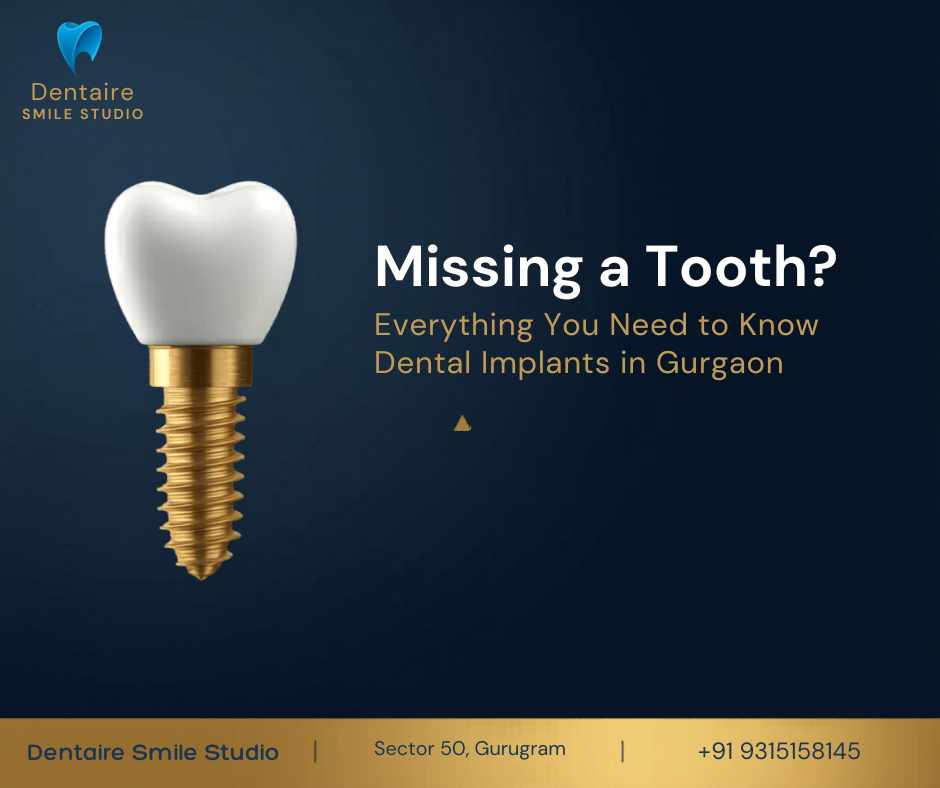
A dental implant is a titanium screw — typically 3–5 mm wide and 8–16 mm long — that is surgically placed into the jawbone to replace the root of a missing tooth. Over a period of weeks to months, the bone grows around and bonds with the titanium surface in a process called ओसियोइंटीग्रेशन. Once integrated, a connector piece (the abutment) is attached, and a custom-made crown is placed on top.
The final result: a tooth that looks, feels, and functions exactly like a natural tooth — with a root firmly embedded in the bone, capable of withstanding normal bite forces for decades.
This is the fundamental difference between an implant and every other tooth replacement option. A bridge sits on top of adjacent teeth. A denture sits on top of the gum. Only an implant replaces the actual root — which is what preserves the jawbone and makes the restoration feel like your own tooth.
Part 1: The Three Options When You Lose a Tooth
When a tooth is missing — whether from decay, trauma, gum disease, or extraction — you have three realistic options. Each has genuine advantages and real drawbacks. Here they are, honestly.
Option 1: Dental Implant
What it is: A titanium root surgically placed in the jawbone, topped with a crown.
How long it lasts: With proper care, dental implants can last for several decades and in some cases a lifetime. Major implant brands such as Straumann and Nobel Biocare consistently show success rates of about 95–98% at 10 years.
What it does to adjacent teeth: Nothing. The implant is completely independent — no neighbouring tooth is touched, filed, or permanently altered.
What it does to your jawbone: Preserves it. The titanium root stimulates the bone the way a natural root does, preventing the resorption (shrinkage) that occurs when a tooth is missing.
Cost in Gurgaon (2026): roughly ₹28,000 – ₹75,000 per tooth, depending on implant brand, bone condition, and crown material. More on this below.
Timeline: 3–6 months for most standard cases (including healing time).
Best for: Single missing teeth, multiple missing teeth, patients who want a permanent, fixed solution that preserves bone and doesn’t involve adjacent teeth.
Option 2: Dental Bridge
What it is: A false tooth (called a pontic) held in place by crowns on the two teeth adjacent to the gap. The bridge is fixed — cemented permanently — but it sits above the gumline and does not have a root in the bone.
How long it lasts: Dental bridges typically last 5–15 years, while dental implants are designed to be a permanent solution and can last a lifetime with proper care.
What it does to adjacent teeth: Requires filing down healthy adjacent teeth for a bridge, which makes no sense when the bone can hold a screw. The neighbouring teeth are permanently altered to serve as anchors — even if they were perfectly healthy before.
What it does to your jawbone: Nothing — and that is the problem. Without a root in the bone, the area under the missing tooth gradually loses bone volume. Over years, this causes a visible dip in the gum under the bridge and changes the appearance of the restoration.
Cost in Gurgaon (2026): ₹15,000 – ₹30,000 for a three-unit bridge (two crowns + one pontic).
Timeline: 2–3 appointments over 2–3 weeks.
Best for: Patients who cannot have surgery for medical reasons, or who need a faster and more affordable solution for multiple adjacent missing teeth with strong neighbouring teeth.
Option 3: Removable Denture
What it is: A removable appliance — either a full denture (replaces all teeth in a jaw) or a partial denture (clips onto remaining teeth to fill gaps).
How long it lasts: Dentures last 5–8 years. As your jawbone shrinks over time, the dentures will become loose, and you will need to have them relined or completely replaced every five to seven years.
What it does to adjacent teeth: Partial dentures use metal clasps that clip onto natural teeth, placing repeated stress on them over years.
What it does to your jawbone: Dentures press down on the gums during chewing. This constant pressure actually speeds up the loss of the underlying jawbone.
Cost in Gurgaon (2026): ₹5,000 – ₹30,000 depending on the type and number of teeth replaced.
Timeline: 2–5 appointments over 3–4 weeks.
Best for: Patients missing most or all of their teeth with limited bone, or those for whom surgery is medically unsuitable, or where budget is the primary constraint.
The Honest Comparison Table
| Implant | Bridge | Denture | |
|---|---|---|---|
| Looks like natural teeth | ✅ Best | ✅ Good | ⚠️ Acceptable |
| Feels like natural teeth | ✅ Best | ✅ Good | ❌ Poor |
| Preserves jawbone | ✅ Yes | ❌ No | ❌ No (accelerates loss) |
| Affects adjacent teeth | ✅ No | ❌ Permanently files them | ⚠️ Clips onto them |
| Removable | ❌ Fixed | ❌ Fixed | ✅ Removable |
| Lifespan | ✅ 20+ years / lifetime | ⚠️ 7–15 years | ❌ 5–8 years |
| Initial cost | ⚠️ Higher | ✅ Lower | ✅ Lowest |
| Long-term cost | ✅ Lowest | ⚠️ Medium | ❌ Highest (repeat replacement) |
| Cleaning | ✅ Brush normally | ✅ Use floss threader | ⚠️ Remove and soak |
| Chewing efficiency | ✅ 100% | ✅ Good | ❌ 30–50% of natural |
The key insight: Bone loss only stops with implants. Bridges and dentures do not stimulate the jawbone. The ridge where teeth used to be resorbs slowly over years. Only an implant screw inside the bone prevents that. The wrong choice costs more long term than spending more upfront on the right one.
Part 2: Dental Implant Cost in Gurgaon — The Complete 2026 Breakdown
This is the question everyone comes in with, and the answer most clinics give is frustratingly vague. Let me give you real numbers.
What Goes Into the Total Cost
A dental implant involves three separate components — and a real quote must include all three. Any quote that seems unusually low is almost certainly quoting only one or two:
1. The Implant Fixture (the titanium screw): ₹10,000 – ₹40,000 depending on brand. 2. The Abutment (the connector): Often included with the implant, sometimes quoted separately. ₹3,000 – ₹8,000. 3. The Crown (the visible tooth): ₹5,000 – ₹20,000 depending on material (PFM ceramic vs. full zirconia).
There may also be additional costs for:
- CBCT (3D scan): ₹2,000 – ₹4,000 — essential for proper implant planning; not optional in a quality clinic
- Bone grafting (if needed): ₹8,000 – ₹25,000 — required when bone volume is insufficient
- Tooth extraction (if the failing tooth is still present): ₹800 – ₹3,000
- Sinus lift (for upper back teeth with low sinus floor): ₹15,000 – ₹35,000
All-In Price Ranges in Gurgaon (2026)
| प्रक्रिया | Price Range |
|---|---|
| Single tooth implant (standard brand, PFM crown) | ₹28,000 – ₹45,000 |
| Single tooth implant (premium brand, zirconia crown) | ₹45,000 – ₹75,000 |
| Implant-supported bridge (3-unit) | ₹70,000 – ₹1,20,000 |
| All-on-4 (full arch, one jaw) | ₹2,50,000 – ₹5,00,000 |
| All-on-6 (full arch, one jaw) | ₹3,50,000 – ₹6,50,000 |
| Bone graft (if required) | ₹8,000 – ₹25,000 |
These are all-inclusive ranges as of June 2026. Costs vary by clinic quality, implant brand, and whether additional procedures are needed.
Part 3: Implant Brands — What Actually Matters
When a clinic tells you they use “international brand implants,” ask specifically which brand. Here is an honest breakdown of the major systems used in Gurgaon.
Tier 1 — Premium International (Highest Evidence Base)
Straumann (Switzerland) Straumann implants achieve a long-term success rate of approximately 98–99% over 10 years. Their SLActive surface technology accelerates bone integration. Straumann and Nobel Biocare have the most extensive independent published outcome data — 10, 15, and 20-year follow-up studies from multiple research groups. This is a genuine distinction from newer or volume-priced brands. Cost in Gurgaon: ₹35,000 – ₹65,000 per implant (fixture + abutment + crown)
Nobel Biocare (Sweden/USA) Nobel Biocare implants boast high survival rates, with studies showing success rates of over 95% after 10 years. Nobel Biocare is the world leader in All-on-4 full-arch implant systems. Cost in Gurgaon: ₹40,000 – ₹65,000 per implant
Tier 2 — Premium Korean Systems (Excellent Value)
Osstem (South Korea) Korean brands like Osstem and MegaGen are known for their high quality, significant investment in R&D, and excellent value. They are among the most popular and reliable implants used in India and worldwide. Osstem is the highest-volume implant manufacturer in Asia and well-documented with strong clinical outcomes. Cost in Gurgaon: ₹25,000 – ₹45,000 per implant
MegaGen AnyRidge (South Korea) MegaGen’s AnyRidge design features a variable thread pitch designed to achieve high primary stability across all bone densities. The Xpeed surface accelerates osseointegration. AnyRidge is increasingly used in immediate loading cases and has growing published follow-up data. Cost in Gurgaon: ₹30,000 – ₹55,000 per implant
What “Generic” or “Indian Brand” Means — And Why It Matters
Some clinics advertise implants at ₹8,000 – ₹15,000. These typically use unbranded or replica components, or non-FDA approved systems. Lower quotes often use generic or replica parts or non-FDA approved systems. This results in bone loss, exposed threads, and implant failure in 4–5 years.
A failed implant requires surgical removal, bone grafting to restore the lost bone, and then re-implantation. The total cost of a failed ₹10,000 implant can exceed ₹1,00,000 by the time it is properly corrected. This is not a theoretical risk — it is something we see in our clinic regularly from patients who initially went to budget providers.
The most important variable is not the brand alone — it’s the surgeon. Brand quality reduces risk, but clinical execution determines success. An excellent surgeon with Osstem will consistently outperform an inexperienced surgeon with Straumann.
Part 4: The Implant Procedure — What Actually Happens
Many patients avoid implants because they imagine a complex, painful surgery. The reality is considerably more straightforward.
Step 1: Consultation and 3D CBCT Scan (Visit 1)
Before any implant, a CBCT (Cone Beam CT) scan is essential. This is a low-radiation 3D scan of your jawbone that shows bone height, width, density, and the precise location of nerves, sinuses, and blood vessels. Any clinic placing implants without a CBCT is guessing at dimensions that need to be exact.
The scan guides the selection of implant size and the precise drilling angle. It also identifies whether bone grafting is needed before implant placement.
Step 2: Implant Placement Surgery (Visit 2)
Under local anaesthesia — the same type used for a filling — the gum is opened to access the bone. A series of precisely sized drills creates a channel, and the implant is placed and tightened to a measured torque. The gum is closed with a few sutures.
The procedure typically takes 30–60 minutes per implant. Most patients describe it as feeling pressure but no pain. Post-operative discomfort is typically managed with standard painkillers for 2–3 days.
Step 3: Healing (Osseointegration) — 6–12 Weeks
This is the waiting period — not because anything is being done, but because biology needs time. The bone is growing into the surface of the titanium implant. During this period, most patients go about their normal lives with a temporary tooth (if aesthetically necessary).
Step 4: Abutment Placement and Crown Fitting (Visit 3–4)
Once osseointegration is confirmed, the abutment is attached. An impression (or digital scan) of the area is taken, and a custom crown is fabricated in a dental lab. The crown is then fitted and adjusted for bite.
Total visits for a standard single implant: 3–4 visits over 3–5 months.
Part 5: Who Is a Good Candidate for Implants?
Most healthy adults with a missing tooth are candidates. The key requirements are:
✅ Adequate bone volume — if bone has been lost, grafting can often rebuild it before implant placement
✅ Healthy gums — active gum disease must be treated before implant surgery; periodontal health is essential for long-term implant success
✅ No uncontrolled systemic disease — well-controlled diabetes, hypertension, and most other systemic conditions do not disqualify patients; uncontrolled diabetes does increase implant failure risk
✅ Non-smoker or willing to quit around surgery — smoking significantly impairs healing and increases implant failure rates
✅ Sufficient age — jaw growth must be complete; typically 18+ for most patients
Conditions that require extra planning (but don’t necessarily disqualify):
- Diabetes (well-controlled)
- Osteoporosis
- History of bisphosphonate medication
- Previous radiation to the jaw
- Thin or low bone volume
Part 6: 5 Red Flags to Watch for When Choosing an Implant Clinic
This section is important — and most dental websites won’t write it.
🚩 Red Flag 1: Very low quoted prices If a clinic quotes ₹8,000 – ₹15,000 for a complete implant, ask specifically: does this include the implant fixture, the abutment, AND the crown? If yes, ask which brand of implant. Implant components alone from a reputable brand cost more than that. A quote that sounds too good almost always means replica parts, generic components, or a procedure performed by someone with minimal implant training.
🚩 Red Flag 2: No CBCT scan before surgery Placing an implant without a 3D scan is like performing surgery blindfolded. A CBCT is not optional — it is how the surgeon maps the exact location of nerves, sinuses, and bone boundaries. Any clinic that skips this is cutting corners that affect your safety.
🚩 Red Flag 3: Implants placed in single very quick appointments Implant placement surgery should not feel rushed. The procedure requires precision, proper sterilisation protocols, and measured drilling torques. A “10-minute implant” is a warning sign.
🚩 Red Flag 4: Implants placed by a general dentist without implant specialisation True implant specialists are MDS Prosthodontists, Oral Surgeons, or Periodontists. Short-term implant courses are falsely marketed as specialisation. Ask about the dentist’s specific training in implantology.
🚩 Red Flag 5: No discussion of bone grafting when indicated If a patient has been missing a tooth for 2+ years, bone loss has almost certainly occurred. A clinic that quotes a standard implant without assessing bone adequacy on a CBCT is either not looking carefully, or is telling you what you want to hear.
Implant Aftercare: Making Your Investment Last
A well-placed implant with proper care can genuinely last the rest of your life. Here is what “proper care” actually means:
Daily:
- Brush twice daily — an electric toothbrush is ideal for keeping the gum margin clean around the crown
- Floss daily, or use an interdental brush around the implant
- The implant crown cannot decay, but the gum around it can develop peri-implantitis (implant gum disease) if plaque accumulates
Ongoing:
- Professional cleaning every 6 months — your hygienist uses specific instruments safe for implant surfaces
- Tell your dentist if you notice any mobility, pain, or gum changes around the implant — these are rare but must be evaluated promptly
- Night guard if you grind your teeth — bruxism places enormous forces on implant crowns and can fracture them over time
Avoid:
- Chewing on very hard objects (ice, hard candy, pens) — this applies to natural teeth and implant crowns equally
- Smoking — it impairs blood supply to the gum and bone and is the single biggest cause of late implant failure
Frequently Asked Questions About Dental Implants
Q: How much does a dental implant cost in Gurgaon? A: A complete single tooth implant in Gurgaon in 2026 — including the titanium fixture, abutment, and crown — ranges from ₹28,000 to ₹75,000 depending on the implant brand (Osstem vs. Straumann/Nobel Biocare) and crown material (PFM ceramic vs. full zirconia). Additional procedures like bone grafting or sinus lifting add to the cost if required. A quote that includes only the “screw” and not the abutment and crown is not a complete price.
Q: How painful is a dental implant procedure? A: The procedure is performed under local anaesthesia and most patients report feeling pressure but no pain during surgery. Post-operative soreness for 2–3 days is typical and managed with standard painkillers. Most patients return to normal activities the next day.
Q: How long do dental implants last? A: With proper care and maintenance, dental implants from major brands (Straumann, Nobel Biocare, Osstem) have documented survival rates of 95–99% at 10 years, and many patients have functioning implants after 20–30 years. The crown on top may need replacement after 15–20 years; the titanium root itself rarely fails when placed correctly.
Q: Is dental implant better than a bridge? A: For a single missing tooth with healthy adjacent teeth, an implant is almost always the better long-term choice. It preserves bone, doesn’t touch the neighbouring teeth, and lasts longer. A bridge requires permanently filing down two healthy adjacent teeth and does not prevent jawbone loss under the gap. The long-term cost of repeated bridge replacement often exceeds the upfront cost of an implant.
Q: Can I get a dental implant immediately after tooth extraction? A: In select cases, yes — this is called immediate implant placement and is an option when there is no active infection and adequate bone. It reduces the total treatment time significantly. Not every case is suitable; your surgeon must assess bone quality and socket condition at the time of extraction.
Q: How long does the dental implant process take? A: Most standard single-tooth implant cases are complete in 3–5 months. This includes the healing (osseointegration) period of 6–12 weeks. Cases requiring bone grafting beforehand may take 6–9 months total. In suitable cases, temporary crowns can be placed on the same day as surgery.
Q: What is All-on-4? A: All-on-4 is a full-arch implant solution for patients who have lost most or all teeth in one jaw. Four implants are strategically placed in the jawbone to support a full fixed bridge of 10–14 teeth. It eliminates the need for removable dentures and preserves the remaining bone. Cost in Gurgaon ranges from ₹2,50,000 – ₹5,00,000 per jaw.
Q: Can people with diabetes get dental implants? A: Yes, in most cases — well-controlled diabetes is not a contraindication for implants. However, blood sugar must be well-managed (HbA1c below 7.5–8.0 is typically the threshold) before surgery. Uncontrolled diabetes impairs bone healing and significantly increases implant failure risk. Your dentist should coordinate with your physician before proceeding.
Q: What is peri-implantitis? A: Peri-implantitis is gum disease around a dental implant — similar to periodontitis around natural teeth. It involves bone loss around the implant and, if untreated, can lead to implant failure. It is caused by plaque accumulation, smoking, uncontrolled diabetes, or a history of gum disease. Prevention is through meticulous oral hygiene and regular professional maintenance.
Q: Which is the best implant brand in India? A: Straumann (Switzerland) and Nobel Biocare (Sweden/USA) have the most extensive long-term independent clinical data, with 20-year follow-up studies and success rates consistently above 96–99%. Korean brands Osstem and MegaGen offer strong clinical performance at more accessible prices. The most important factor, however, is the training and experience of the surgeon, not the brand alone.
A Word on Timing
The single most common implant regret I see is waiting. A missing tooth feels manageable in the short term — eating adjusts, appearance adjusts, the discomfort fades. But the bone does not wait.
Bone loss only stops with implants. The ridge where teeth used to be resorbs slowly over years. A tooth missing for six months is a different case from a tooth missing for three years. The longer the gap, the more likely that bone grafting is needed — adding cost, time, and complexity to what would otherwise have been a straightforward procedure.
If you have a missing tooth, or a tooth that your dentist has told you needs to come out, the best time to start the conversation about an implant is now — while your options are at their widest.
We offer a thorough implant consultation at Dentaire Smile Studio — including a clinical examination and a discussion of your specific options, bone condition, and realistic cost range. No pressure, no commitment.
Dentaire Smile Studio is at A127, Nirvana Courtyard Market, Nirvana Country, Sector 50, Gurugram. Open Monday – Saturday, 10 AM – 7:30 PM. 📞 +91 9315158145 | 🌐 dentaire.in
Dr. Aditi Goel is a Microscopic Endodontics Specialist and the founder of Dentaire Smile Studio, Gurgaon. The clinic provides comprehensive implant consultations, full-arch rehabilitation, and precision-guided implant placement for patients across Gurgaon and Delhi NCR.
Related Reading:
 हिन्दी
  English