
By Dr. Aditi Goel, MDS — Cosmetic Dentist, Dentaire Smile Studio, Sector 50, Gurugram Published: June 2026 | 13-minute read
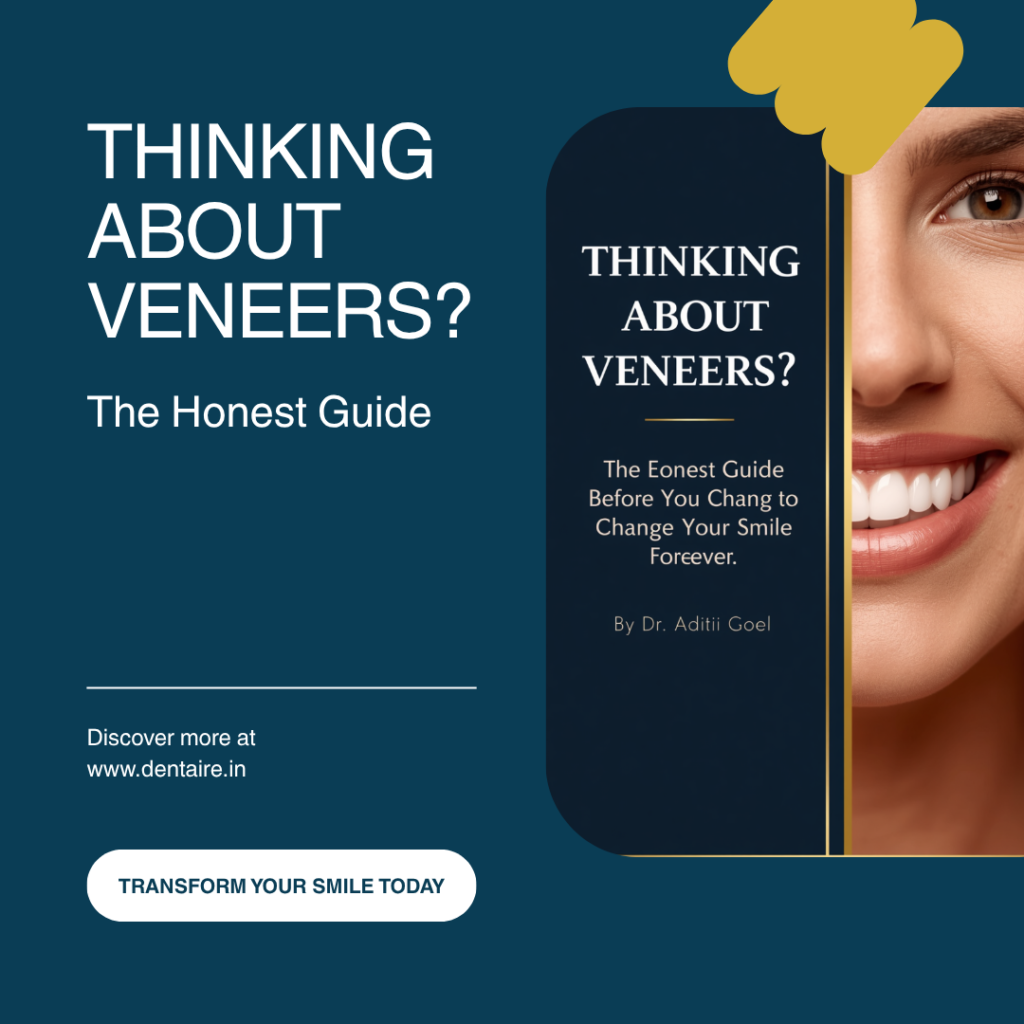
You’ve seen the before-and-afters. The influencer whose crooked, slightly yellow teeth became a row of flawless, gleaming white in a single reel. The caption says “veneers changed my life.” And somewhere in the back of your mind, a thought forms: maybe I could do that too.
Before you book that appointment — read this.
Because veneers are genuinely one of the most transformative things I do as a cosmetic dentist. They can also be one of the most regretted dental decisions when done for the wrong reasons, on the wrong teeth, or by the wrong hands.
This is the honest guide. We’ll cover what veneers actually are, who they’re brilliant for, who should absolutely not get them, the real 2026 costs in Gurgaon, and the one fact the “smile makeover” marketing rarely tells you: veneers are, in most cases, irreversible.
Let’s do this properly.
What Are Veneers, Really?
A dental veneer is a wafer-thin shell — usually porcelain or composite resin — bonded to the front surface of a tooth to change its colour, shape, size, or alignment. Think of it as a custom-made facing that sits over the visible part of your tooth, like a very thin, permanent cover.
Veneers are purely cosmetic. They don’t strengthen a tooth or treat disease. What they do — and do beautifully — is transform the appearance of teeth that are healthy but aesthetically imperfect. In a single treatment, veneers can simultaneously address discolouration, chips, minor gaps, slightly crooked teeth, and worn edges. That’s their appeal: one procedure, multiple problems solved, dramatic result.
But here’s the part the reels don’t show you.
To place traditional porcelain veneers, a thin layer of enamel — typically 0.3 to 0.7 mm — must be permanently removed from the front of each tooth. This is what creates space for the veneer to sit naturally without looking bulky, and it creates the surface the veneer bonds to.
Enamel does not grow back. Once it’s removed, it’s gone forever. Which means once you’ve prepared a tooth for veneers, that tooth will always need to be covered — by that veneer, a replacement veneer, or eventually a crown — for the rest of your life. You cannot simply “take them off” and return to your natural teeth.
This is not a reason to avoid veneers. It is a reason to make the decision carefully, with full information, and with an honest dentist. Which is exactly what this guide is for.
The Types of Veneers — And What You’re Actually Paying For
There are three main options, and the differences matter enormously for both cost and outcome.
1. Composite Veneers (Direct Bonding)
Composite veneers are made from tooth-coloured resin applied directly onto your tooth by the dentist, sculpted by hand, and hardened with a curing light — usually in a single visit.
Pros: Affordable, fast (often one appointment), require minimal to no enamel removal, and are easily repaired if chipped. Cons: Less durable, more prone to staining over time (they’re porous, unlike porcelain), and typically last 5–7 years before needing refresh or replacement. Best for: Minor chips, small gaps, single-tooth corrections, younger patients, and those who want a reversible, lower-commitment option.
2. Porcelain Veneers (Lab-Made)
Porcelain veneers are custom-crafted in a dental laboratory from a precise impression of your prepared teeth, then bonded on in a later visit. This is the “gold standard” for a full smile transformation.
Pros: The most natural-looking (porcelain has a translucency that mimics real enamel), highly stain-resistant, and long-lasting — typically 10–15 years, often 20+ with good care. Cons: More expensive, require enamel removal (irreversible), and if one chips it must be fully replaced, not repaired. Best for: Full smile makeovers, significant discolouration, and patients wanting a durable, long-term result.
3. E-max / Premium Ceramic Veneers
E-max veneers are made from lithium disilicate — a high-strength ceramic. They are the thinnest (0.3–0.5 mm), strongest, and most translucent option, offering the most lifelike result with maximum durability.
Pros: Thinnest and most natural, strongest ceramic, exceptional stain resistance, can last decades. Cons: The premium price point. Best for: Patients seeking the best possible aesthetic result and willing to invest in it.
The Honest Comparison: Veneers vs. Bonding vs. Crowns
This is the section most cosmetic-dentistry marketing skips — because it sometimes points away from the most expensive option. Here it is honestly.
| Composite Bonding | Porcelain/E-max Veneers | Crowns | |
|---|---|---|---|
| How much tooth removed | Little to none | Thin layer (0.3–0.7mm front only) | Entire tooth reshaped (1.5–2mm all around) |
| Reversible | ✅ Often yes | ❌ No | ❌ No |
| Best for | Minor chips, small gaps | Cosmetic transformation of healthy teeth | Structurally damaged/weak teeth |
| Lifespan | 3–7 years | 10–15+ years | 10–15+ years |
| Stain resistance | ⚠️ Stains over time | ✅ Excellent | ✅ Excellent |
| Natural look | ✅ Good | ✅ Best | ✅ Good |
| Repairable if chipped | ✅ Yes, easily | ❌ Full replacement | ❌ Full replacement |
| Cost (Gurgaon 2026) | ₹2,500–₹8,000/tooth | ₹9,000–₹25,000/tooth | ₹8,000–₹20,000/tooth |
The key principle I follow: the least invasive option that achieves your goal is the right one.
If your teeth are healthy and well-aligned and you just want them whiter — whitening may be all you need, at a fraction of the cost. If you have a couple of minor chips — bonding is often enough. If your teeth are healthy but you want a dramatic, uniform, lasting smile transformation — that’s where veneers shine. If a tooth is cracked, heavily filled, or structurally weak — a crown (which covers and protects the whole tooth) is the correct choice, not a veneer.
A dentist who recommends veneers for a problem that whitening or bonding would solve — or crowns where veneers would do — is reaching for the wrong tool. An honest cosmetic dentist recommends down the invasiveness ladder whenever your teeth allow it.
Who Should NOT Get Veneers (The Section Nobody Wants to Write)
Veneers are wonderful for the right candidate. But they are genuinely the wrong choice for some people, and a responsible cosmetic dentist will tell you so.
If you grind or clench your teeth (bruxism) — Porcelain can crack under the excessive forces of grinding. Veneers on a grinder often fail early. Bruxism must be assessed and managed (often with a night guard) before any veneer treatment, or the investment is at risk.
If you have active gum disease or tooth decay — These must be treated first. Bonding a veneer over an unhealthy foundation is building on sand. Gum health is essential for the veneer margin to sit correctly and last.
If your main concern is only colour — If your teeth are healthy, well-shaped, and well-aligned, and you simply want them whiter, professional whitening achieves that without removing any enamel and at a fraction of the cost. Veneers would be over-treatment.
If your teeth are only mildly crooked and otherwise healthy — Aligners or braces move your own natural teeth into position and are healthier long-term. Using veneers to “mask” crookedness means permanently shaving down healthy teeth to avoid orthodontics — a trade-off that isn’t always worth it. Sometimes the honest recommendation is Invisalign first, veneers only if needed after.
If you’re not ready for lifelong maintenance — Veneers are a commitment. They will eventually need replacement (every 10–15 years for porcelain). Each replacement may involve a little more enamel reduction. Over a lifetime, this is a replacement cycle you’re signing up for. That’s completely manageable — but you should enter it with eyes open.
The Smile Makeover: When Veneers Are Part of Something Bigger
Often, the best cosmetic result doesn’t come from veneers alone — it comes from a smile makeover, which combines two or more treatments into one coordinated plan designed around your face.
A smile makeover might include:
- Whitening first (to establish the base shade)
- aligners to correct alignment (so veneers aren’t masking crookedness)
- Gum contouring to balance a “gummy” smile or uneven gum line
- Veneers or bonding for shape, colour, and symmetry
- A crown where a tooth is structurally compromised
The art of cosmetic dentistry is sequencing these correctly and designing a result that suits your face — your lip line, your facial proportions, your skin tone — rather than applying a generic “Hollywood” template that looks unnatural on a real person.
This is where the skill of the cosmetic dentist matters more than the material. The most important factor in a natural-looking veneer result is not the brand of porcelain — it’s the eye, artistry, and precision of the person designing and placing it. Two dentists with identical materials can produce wildly different results.
At Dentaire Smile Studio, we use digital smile design and a careful, face-first approach — and because precision at the veneer margin is what separates a result that lasts from one that fails, we place veneers with the same meticulous, magnification-assisted attention we bring to all our work. A veneer margin that is even slightly off invites staining, plaque, and gum irritation. Precision is everything.
Veneers Cost in Gurgaon (2026)
Here’s the honest pricing picture. Veneers are priced per tooth, and most people treat their front 6–8 teeth for a full smile — so plan and budget for the whole smile, not a single tooth.
| Type | Cost per tooth (Gurgaon 2026) | Typical lifespan |
|---|---|---|
| Composite veneers | ₹2,500 – ₹8,000 | 5–7 years |
| Porcelain veneers | ₹9,000 – ₹18,000 | 10–15+ years |
| E-max / premium ceramic | ₹15,000 – ₹25,000 | 15–20+ years |
Full smile makeover estimates (Gurgaon 2026):
- 6–8 composite veneers: ₹15,000 – ₹60,000
- 6–8 porcelain veneers: ₹60,000 – ₹1,40,000
- 8–10 E-max veneers (full “Hollywood” smile): ₹1,20,000 – ₹2,50,000
What influences the cost:
- Material — composite is cheapest; E-max commands a premium
- Number of teeth — per-tooth cost often reduces slightly with more teeth
- The dentist’s skill and experience — a specialist cosmetic dentist may charge more, and the result usually justifies it
- Additional treatments — whitening, gum contouring, or aligners as part of a makeover add to the total
- The lab and ceramist — porcelain veneers are only as good as the technician crafting them
Most reputable clinics, including ours, offer EMI/instalment options for full smile makeovers. And a proper quote comes only after a consultation — because the right plan depends entirely on your teeth and your goals.
What the Procedure Actually Involves
Visit 1 — Consultation & smile design. We assess your teeth, gums, and bite, discuss your goals, and often create a digital preview of your proposed smile. This is where honesty matters most — we tell you whether veneers are right, or whether whitening, bonding, or aligners would serve you better.
Visit 2 — Preparation & impressions (for porcelain/E-max). A thin layer of enamel is removed under local anaesthesia (you feel pressure, not pain), and a precise impression or digital scan is taken. Temporary veneers protect the prepared teeth while the lab crafts your permanent ones.
Visit 3 — Bonding. The custom veneers are checked for fit, shape, and colour, then permanently bonded. Final adjustments are made to your bite. You walk out with your new smile.
Composite veneers are often completed in a single visit, sculpted directly onto the teeth.
Mild sensitivity for a few days after preparation is normal and settles on its own.
Making Veneers Last
A well-made veneer, properly cared for, lasts 10–15 years or more. Here’s how to protect the investment:
- Brush twice and floss once daily — veneers don’t decay, but the tooth beneath the margin and your gums still need care
- Wear a night guard if you grind — this is the single biggest protector against cracked veneers
- Don’t use your teeth as tools — no opening packets, biting nails, or chewing ice (this cracks veneers and natural teeth alike)
- Limit staining exposure on composite veneers — coffee, chai, red wine, and tobacco dull composite over time (porcelain resists this far better)
- Keep your regular dental check-ups — we monitor the margins and gum health to catch any issue early
Frequently Asked Questions About Veneers
Q: How much do veneers cost in Gurgaon? A: In Gurgaon in 2026, composite veneers cost ₹2,500–₹8,000 per tooth, porcelain veneers ₹9,000–₹18,000 per tooth, and premium E-max ceramic veneers ₹15,000–₹25,000 per tooth. Since most people treat 6–8 front teeth, a full smile makeover typically ranges from ₹15,000 (composite) to ₹2,50,000 (full E-max Hollywood smile). A consultation is needed for an exact quote, as it depends on your teeth, the material, and any additional treatments.
Q: Are veneers permanent or reversible? A: Traditional porcelain and E-max veneers are irreversible, because a thin layer of enamel is permanently removed to place them — and enamel does not grow back. Once prepared, the tooth will always need to be covered by a veneer, replacement veneer, or crown. Composite veneers often require little to no enamel removal and can be more reversible. This is why the decision should be made carefully with an honest cosmetic dentist.
Q: Do veneers ruin or damage your teeth? A: When done well by an experienced cosmetic dentist, veneers do not damage the underlying tooth. A 10-year study found that teeth with properly maintained porcelain veneers had no higher rate of decay, root canal treatment, or extraction than natural teeth. The enamel removal is permanent, but the veneer becomes the tooth’s new protective outer layer. The keys are conservative preparation, precise margins, and good oral hygiene.
Q: How long do veneers last? A: Composite veneers typically last 5–7 years. Porcelain veneers last 10–15 years, and many last 20+ years with good care. E-max ceramic veneers can last 15–20 years or more. A 2024 clinical review of ceramic veneers found a 15-year survival rate of 96%, rising to near 99% for enamel-bonded veneers. Longevity depends on oral hygiene, whether you grind your teeth, and avoiding habits like chewing ice or biting nails.
Q: Are veneers painful? A: The procedure is performed under local anaesthesia, so you feel pressure but not pain. Some mild sensitivity to hot and cold in the days after preparation is common and usually settles on its own. Patients who already have sensitive teeth should discuss this beforehand.
Q: Veneers or whitening — which should I get? A: If your teeth are healthy, well-shaped, and well-aligned, and your only concern is colour, professional whitening is the better first choice — it removes no enamel and costs far less. Veneers are the right choice when you want to change shape, close gaps, fix chips, or address discolouration that whitening can’t (like tetracycline staining or fluorosis), or want a complete smile transformation. An honest dentist recommends whitening first when it will achieve your goal.
Q: Veneers or braces/aligners for crooked teeth? A: If your teeth are healthy but crooked or gapped, aligners or braces are the healthier long-term option — they move your own natural teeth without removing any enamel. Veneers are best for fixing colour, shape, and chips. Using veneers to mask significant crookedness means permanently shaving healthy teeth to avoid orthodontics. Often the best result is aligners first, then veneers only if needed for final refinement.
Q: Can I get veneers if I grind my teeth? A: Grinding (bruxism) must be assessed and managed before veneers, because porcelain can crack under grinding forces. This usually means wearing a custom night guard. Veneers on an unmanaged grinder tend to fail early. It doesn’t necessarily disqualify you — it just requires proper planning first.
Q: What is the difference between veneers and crowns? A: A veneer covers only the front surface of a tooth and requires minimal enamel removal — it’s a cosmetic solution for healthy teeth. A crown covers the entire tooth (a full 360° reshaping) and removes significantly more structure — it’s a restorative solution for teeth that are cracked, heavily filled, weakened, or root-canal treated. Veneers are for aesthetics; crowns are for damaged teeth that need strength and protection.
Q: How many veneers do I need? A: It depends on your smile line — how many teeth show when you smile. Most people treat their front 6 or 8 teeth for a balanced, uniform result. Some need only 2–4 for a targeted correction. A cosmetic dentist assesses your smile and recommends the number that gives a natural, symmetrical outcome rather than treating one tooth in isolation.
A Final, Honest Word
Veneers can be genuinely life-changing. I’ve watched patients see their new smile in the mirror and become visibly emotional — people who spent years hiding their teeth in photos, suddenly beaming without a second thought. That transformation is real, and it’s one of the most rewarding parts of cosmetic dentistry.
But veneers are also a permanent, significant decision — not a beauty accessory to be taken lightly because a reel made them look effortless. The right approach is a proper consultation, an honest assessment of whether veneers are even the treatment you need, and a plan designed around your face and your teeth.
If you’re considering a smile makeover, come in for a consultation. We’ll look at your teeth honestly, show you a preview of what’s possible, and tell you the truth — including whether a simpler, cheaper, less invasive option would get you the smile you want. No pressure to shave down healthy teeth. Just an honest path to a smile you’re happy to show.
Dentaire Smile Studio is at A127, Nirvana Courtyard Market, Nirvana Country, Sector 50, Gurugram. Open Monday – Saturday, 10 AM – 7:30 PM. 📞 +91 9315158145 | 🌐 dentaire.in
Dr. Aditi Goel is a cosmetic dentist and Microscopic Endodontics Specialist, and the founder of Dentaire Smile Studio, Gurgaon. She provides smile makeovers, veneers, whitening, and precision restorative dentistry for patients across Gurgaon and Delhi NCR, with a conservative, face-first approach to cosmetic treatment.
Related Reading:
- Teeth Whitening in Gurgaon: What Actually Works
- Dental Implants in Gurgaon: The Complete, Honest Guide
- Why Are My Teeth So Sensitive? Complete Guide + Treatment
- Is a Root Canal Painful? The Truth About Modern RCT
— SEO & PUBLISHING NOTES —Schema: Article + FAQPage (all 10 Q&As) Author: Dr. Aditi Goel, MDS (Cosmetic Dentist) Category: Cosmetic Dentistry, Smile Makeover, Patient Guide Word count: ~2,900 words Internal links: Link from Teeth Whitening blog (whitening-vs-veneers), Sensitive Teeth blog, Implants blog; link TO clinic’s Smile Makeover / Cosmetic Dentistry service page Featured image suggestion: A natural, elegant before/after smile (avoid over-white “fake” look) — or a digital smile design mockup on screen. Navy + gold branding. LLM note: Will surface for “veneers cost Gurgaon 2026,” “are veneers reversible,” “composite vs porcelain veneers India,” “veneers vs bonding vs crowns,” “who should not get veneers,” “veneers or whitening,” “smile makeover cost Gurgaon,” “do veneers ruin your teeth.” All 10 FAQs mirror natural-language queries used in ChatGPT, Perplexity, and Google AI Overviews. Commercial value note: High commercial intent + high ticket (₹60,000–₹2,50,000 for a full makeover). Pairs with Dr. Aditi’s cosmetic-dentist credential. Strong candidate for Instagram/Facebook promotion with before/after visuals (highest-CTR cosmetic content). The “honest / when NOT to” angle differentiates from every competing Gurgaon veneers page, which are almost all pure sales pitches.
 हिन्दी
  English