
By Dr. Aditi Goel, MDS — Dentaire Smile Studio, Sector 50, Gurugram Published: May 2026 | 12-minute read
It starts innocently enough — a sip of chai that’s slightly too hot, a spoonful of ice cream at a birthday party, a breath of cold morning air on the way to the metro. And then: that sharp, electric jolt that shoots straight up into your jaw and vanishes in seconds.
You grimace. You move on. And you quietly start avoiding the foods you love.
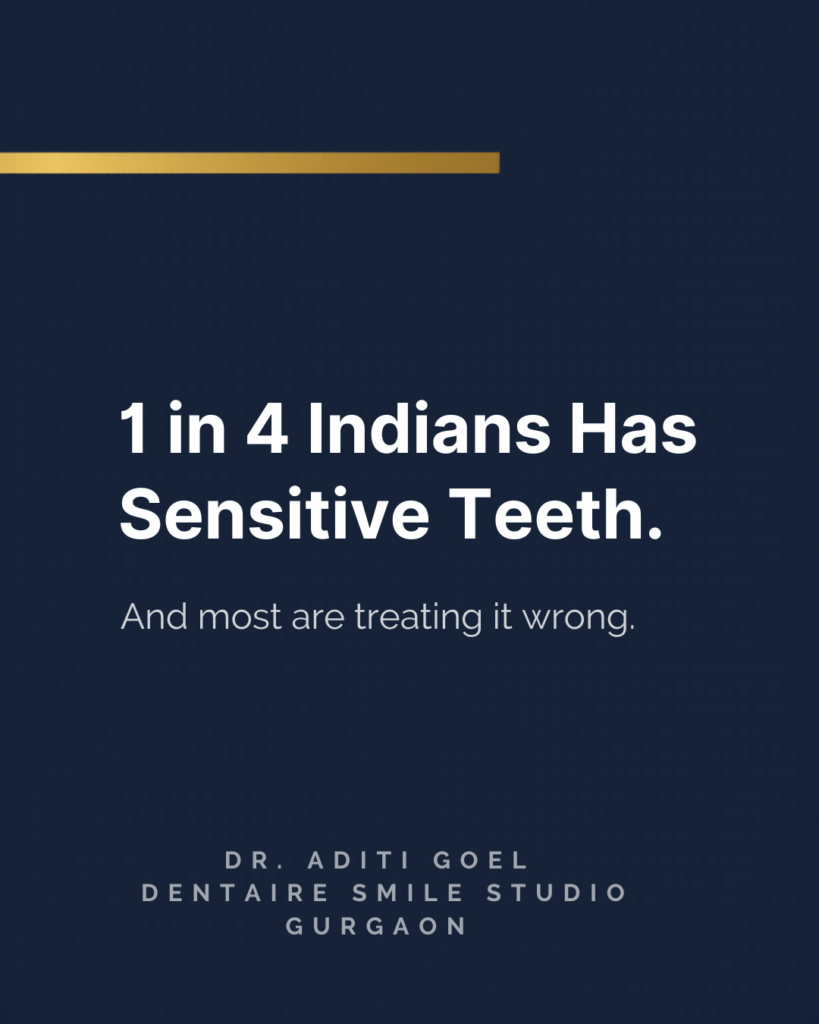
If this sounds familiar, you are far from alone. Sensitive teeth — clinically known as dentinal hypersensitivity — affect somewhere between 20% and 32% of Indian adults, according to multiple peer-reviewed Indian studies. That’s roughly one in four or five people in this country experiencing real, daily pain around something as basic as eating.
And yet, only about 15% of those affected ever seek treatment. The rest learn to live with it, or reach for a tube of “sensitive” toothpaste and hope for the best.
This guide is for everyone who has been doing the latter. We’re going to cover exactly what’s happening inside your tooth when it hurts, the most common causes I see in my patients at Dentaire Smile Studio — several of which will surprise you — and what actually works, both at home and in the clinic.
First: What Is Happening Inside a Sensitive Tooth?
To understand sensitivity, you need to understand your tooth’s basic anatomy. The outer layer of the tooth crown is enamel — the hardest substance in the human body. Beneath it lies a yellowish layer called dentin, which is softer and riddled with thousands of microscopic channels called dentinal tubules. These tubules run from the tooth surface all the way to the nerve at the centre (the pulp).
When enamel wears down, or when gums recede and expose the root (which has no enamel protection at all), these tubules become exposed. Anything that disturbs the fluid inside them — temperature change, sugar, acid, physical touch — sends a pressure signal racing to the nerve. The result is that sharp, sudden pain.
This is called the hydrodynamic theory of sensitivity, and it’s the most widely accepted explanation in dentistry for why sensitive teeth hurt. Knowing this is important, because it explains why the best treatments work by physically blocking those tubules — not just numbing the nerve.
The 7 Real Causes of Sensitive Teeth (Number 4 Surprises Most People)
1. Brushing Too Hard, or With the Wrong Brush
This is the single most common cause I see. The Indian habit of vigorous, horizontal scrubbing with a medium or hard-bristled brush is incredibly damaging. A 2025 review published in the journal Healthcare confirmed that aggressive or incorrect brushing technique causes both cervical abrasion (wearing away the tooth surface near the gum line) and gum recession — both of which directly expose dentinal tubules.
Healthy enamel is 2–3 mm thick at the crown. It doesn’t grow back. Once it’s worn away, it’s gone.
The fix: Switch to a soft-bristled brush immediately. Use gentle, circular strokes. If you’re not sure of your technique, we can show you at your next visit — it’s a five-minute lesson that can save you years of sensitivity.
2. Gum Recession and Gum Disease
Studies in India consistently find gum recession as the leading predisposing factor for sensitivity — present in about 28% of cases. When gums pull away from the tooth surface (often from aggressive brushing, gum disease, or simply ageing), they expose the root, which has no enamel layer at all. Root surface is softer and far more vulnerable to pain triggers.
Gum disease (periodontitis) accelerates this process dramatically. Inflamed, infected gums shrink. The bone underneath also begins to recede. This is a medical issue that needs professional treatment — not more toothpaste.
3. Acidic Foods and Drinks
Every time you consume something acidic — and the Indian diet is full of them: nimbu pani, tamarind, tomato-based curries, cola, curd, citrus fruits — the pH in your mouth drops temporarily. At low pH, the minerals that make up enamel (primarily hydroxyapatite) begin to dissolve in a process called erosion.
This is different from mechanical wear. No amount of gentle brushing prevents erosion from an acidic diet. Over months and years, enamel thins progressively, and sensitivity follows.
The Indian context: Cold drinks and fresh lime juice are consumed daily by millions. Sports drinks, marketed as healthy, are actually highly acidic and more erosive than cola in some studies. If you consume them frequently, you are almost certainly experiencing some degree of enamel erosion.
4. Charcoal Toothpaste — A Trend That Is Actively Harming Your Teeth
This one is urgent, and I want to be very direct: if you are using activated charcoal toothpaste, please stop.
I see this constantly in Gurgaon. The trend has been enormous on social media — charcoal toothpaste marketed as a natural, detoxifying whitening solution. Here is what the clinical evidence actually says:
- A 2024 study (published in the journal Materials) found that brushing with activated charcoal toothpowder decreases enamel hardness, increases surface roughness, and causes calcium loss — all signs of enamel damage.
- Most charcoal toothpastes contain no fluoride, the mineral proven to strengthen and remineralise enamel.
- The American Dental Association has explicitly stated there is insufficient evidence that charcoal toothpaste is safe.
- As enamel thins from charcoal abrasion, teeth often look more yellow, not less — because the yellowish dentin underneath becomes visible through the thinner enamel.
The same caution applies to many “herbal” and “natural” tooth powders, especially abrasive ones. Being natural does not mean being safe for enamel. If it’s gritty and it scrubs, it’s very likely damaging.
5. Teeth Grinding (Bruxism)
Many of my patients who grind their teeth at night are unaware they do it until a partner mentions it, or until I point out the telltale wear patterns on their teeth. Bruxism — grinding or clenching — generates enormous forces, up to 250 kg of pressure per square centimetre, that gradually flatten and wear down the biting surfaces of teeth.
As enamel grinds away from the tops of teeth, sensitivity develops. Bruxism is also strongly associated with stress, and with disrupted sleep. It is increasingly common in the high-pressure corporate culture of Gurgaon and Delhi NCR.
6. Teeth Whitening Products
Both over-the-counter whitening strips and professional bleaching can cause temporary sensitivity, particularly during and immediately after treatment. This is well-documented and happens because the bleaching agents (typically hydrogen peroxide or carbamide peroxide) temporarily open dentinal tubules.
The good news: this type of sensitivity is temporary, usually resolving within a few days. Professional whitening, done under dental supervision with appropriate pre- and post-treatment care, carries far less sensitivity risk than unguided home whitening.
7. Cracked Teeth, Old Fillings, and Untreated Decay
A tooth doesn’t have to be visibly broken to be cracked. Micro-cracks in enamel allow stimuli to reach the dentin suddenly and sharply. Old or failing fillings leave gaps that admit bacteria — and eventually, decay approaches the pulp. Untreated cavities are a common cause of sensitivity that patients mistake for “general” teeth sensitivity and treat with toothpaste, when they actually need a filling or root canal.
This is critical: sensitivity toothpaste will not treat an underlying cavity or crack. If your sensitivity is severe, localised to one tooth, or accompanied by spontaneous pain, see a dentist promptly. You may be masking a problem that is getting worse.
What Actually Works: A Treatment Guide by Severity
Here is the honest breakdown — something most dental websites don’t give you.
| Severity | Best Treatment | Timeline |
|---|---|---|
| Mild (occasional, triggers only) | Desensitising toothpaste with fluoride (twice daily, consistent) | 2–8 weeks |
| Moderate (frequent, affecting eating habits) | In-office fluoride varnish or desensitising agents + toothpaste | 1–3 visits |
| Moderate-severe (multiple teeth, persistent) | Dental bonding / sealants to seal exposed root surfaces | 1–2 visits |
| Severe / gum recession | Gum treatment or gum graft; bonding | Multiple visits |
| Localised to one tooth | Full examination; may indicate cavity, crack, or need for RCT | 1 visit to diagnose |
Desensitising Toothpaste: What Works and What Doesn’t
Desensitising toothpastes work via two mechanisms:
- Potassium nitrate (found in Sensodyne, Colgate Sensitive): calms the nerve by hyperpolarising it — essentially making it less reactive. Takes 2–4 weeks of consistent twice-daily use to build up.
- Arginine / calcium carbonate (Colgate Sensitive Pro-Relief): physically plugs dentinal tubules. Can provide relief within minutes when applied directly.
- Stannous fluoride: blocks tubules AND strengthens enamel. Found in Sensodyne Repair & Protect.
Clinical studies from India confirm that both Sensodyne and Colgate Sensitive Pro-Relief reduce sensitivity meaningfully — with 49–61% reduction in air sensitivity scores over 8 weeks of use. These are genuinely effective for mild-to-moderate cases.
The key word is consistent. Using sensitive toothpaste twice daily, every day, and not rinsing immediately after brushing (let it sit on the teeth for 30 seconds) makes a significant difference. Occasional use does very little.
Professional Treatments: When Toothpaste Isn’t Enough
If three to four weeks of consistent toothpaste use hasn’t substantially improved your symptoms, it’s time for professional treatment. Options include:
In-office fluoride varnish: A highly concentrated fluoride is painted onto the sensitive areas. It hardens almost instantly, physically sealing tubules and remineralising enamel. Painless, quick, and often effective within one or two appointments.
Dental bonding: A tooth-coloured resin material is bonded over the exposed root surface, covering the sensitive area completely. Durable, looks natural, and addresses the structural problem rather than just masking symptoms.
Gum grafting: Where significant gum recession has occurred, a gum graft uses tissue (from your palate or a donor source) to cover the exposed root. This is the definitive solution for recession-related sensitivity and also improves the aesthetics and long-term health of the affected area.
Laser desensitisation: A 2025 study conducted in Meerut, India found that a 980 nm diode laser was the most effective method of all for occluding dentinal tubules. This is increasingly available in advanced dental clinics.
At Dentaire Smile Studio, we use our dental operating microscope during any bonding procedure — it allows us to see the margins of the sensitive area with precision, ensuring complete coverage of the exposed dentin. This is the difference between treatment that lasts and treatment that needs to be redone.
6 Things to Do Right Now if Your Teeth Are Sensitive
- Switch to a soft-bristled toothbrush today. If you’ve been using medium or hard, this single change can stop a major cause of ongoing damage.
- Stop charcoal toothpaste if you’re using it. Replace it with a fluoride toothpaste designed for sensitivity (Sensodyne, Colgate Sensitive Pro-Relief, or any fluoride-containing sensitive formula).
- Don’t brush immediately after eating or drinking anything acidic. Wait at least 30 minutes. Your enamel is softer right after acid exposure and brushing then accelerates erosion.
- Use a straw for cold drinks, juices, and carbonated beverages. It dramatically reduces acid contact with your teeth.
- If you grind your teeth, ask about a night guard at your next appointment. It won’t fix existing sensitivity, but it stops further enamel loss while you sleep.
- Book an appointment if your sensitivity is severe, worsening, or localised to one tooth. Don’t treat a cavity with toothpaste.
Frequently Asked Questions About Sensitive Teeth
Q: Is it normal for teeth to be sensitive? A: Sensitivity is extremely common — affecting 20–32% of Indian adults — but it is not something you should simply accept and live with. It is always a signal that enamel has been compromised or gums have receded, and the underlying cause needs to be identified.
Q: Why are my teeth suddenly sensitive? A: Sudden onset sensitivity (especially in a specific tooth) often indicates a new crack, a failing filling, or early-stage decay. This warrants a dental visit, not just a change of toothpaste. If sensitivity has developed gradually across multiple teeth, the cause is more likely enamel erosion or gum recession from brushing technique or diet.
Q: Which toothpaste is best for sensitive teeth in India? A: Clinical evidence supports Sensodyne (potassium nitrate or stannous fluoride formulations) and Colgate Sensitive Pro-Relief (arginine). Both are widely available in India and proven in clinical trials. The key is consistent daily use for at least 4–8 weeks.
Q: Does Sensodyne work for sensitive teeth? A: Yes — clinical studies show 49–61% reduction in sensitivity scores after 8 weeks of twice-daily use. However, Sensodyne is not a cure; it manages symptoms. If your sensitivity is severe or caused by gum disease or a cavity, toothpaste alone will not resolve it.
Q: Can sensitive teeth be permanently cured? A: It depends on the cause. Sensitivity from gum recession can be permanently resolved with a gum graft. Exposed root surfaces can be permanently covered with dental bonding. Enamel erosion cannot be reversed — but it can be stopped from progressing and the symptoms can be substantially reduced with professional treatment and lifestyle changes.
Q: Why does my tooth hurt when I eat ice cream but not when I eat normally? A: Cold is the most common trigger for dentinal hypersensitivity, reported in 92% of cases in Indian studies. Cold temperatures cause the fluid in exposed dentinal tubules to move rapidly, activating the nerve. Heat sensitivity (hot tea, hot food) suggests more significant pulp involvement and may indicate a need for root canal assessment.
Q: Is tooth sensitivity a sign that I need a root canal? A: Not always. Most cases of generalised sensitivity affecting multiple teeth are from enamel erosion or gum recession, not pulp damage. However, if sensitivity is localised to one tooth, triggered by both heat and cold, or involves spontaneous pain (pain without any trigger), those are signs of pulp involvement and warrant a root canal assessment.
Q: Can oil pulling cure sensitive teeth? A: No. There is no clinical evidence that oil pulling reduces dentinal hypersensitivity. While oil pulling may offer modest gum health benefits, it cannot replace enamel, cover exposed root surfaces, or block dentinal tubules. It should not be used as a substitute for dental treatment.
Q: What foods should I avoid with sensitive teeth? A: The primary culprits are acidic foods and drinks (citrus fruits, tamarind, pickles, cola, sports drinks, vinegar-based dishes), very cold foods (ice cream, cold water, kulfi), very hot beverages, and very sweet foods. You don’t need to eliminate these permanently — but reducing frequency, using a straw for cold/acidic drinks, and not brushing immediately after consuming them significantly reduces damage.
Q: How much does sensitive teeth treatment cost in Gurgaon? A: At Dentaire Smile Studio in Gurgaon:
- In-office fluoride varnish application: ₹500–₹1,500 per session
- Dental bonding for exposed root coverage: ₹2,500–₹5,000 per tooth
- Gum grafting (for recession cases): ₹8,000–₹20,000 depending on extent
- Consultation and diagnosis: ₹300–₹500 These are approximate ranges as of 2026. A proper consultation is always needed to diagnose the cause before recommending treatment.
A Note on Waiting
The patients who end up needing the most complex and expensive treatment for sensitivity are usually those who waited the longest.
Enamel that has thinned over five years of hard brushing cannot be replaced. Gum recession that has progressed to significant bone loss requires more extensive treatment. A small cavity masked by sensitivity toothpaste becomes a large cavity, then an abscess, then a root canal.
None of that has to happen. Sensitivity is one of the most treatable dental conditions we deal with, when it’s caught and addressed appropriately.
If you’ve been wincing over your morning chai for the past few months, come in. A single 30-minute consultation can tell you exactly what’s causing it and what will actually fix it.
Dentaire Smile Studio is at A127, Nirvana Courtyard Market, Nirvana Country, Sector 50, Gurugram. We’re open Monday to Saturday, 10 AM – 7:30 PM. 📞 +91 9315158145 | 🌐 dentaire.in | Book online anytime.
Dr. Aditi Goel is a Microscopic Endodontics Specialist and the founder of Dentaire Smile Studio, Gurgaon. She completed her MDS from a leading Indian dental institution and has a particular clinical focus on conservative dentistry, restorative care, and painless treatment protocols. She sees patients from across Gurgaon, South Delhi, and Delhi NCR.
Related Reading:
- Is a Root Canal Painful? The Truth About Modern RCT
- Dental Implants vs. Bridges: Which Is Right for You?
- Why Your Gums Are Bleeding — And When to Worry
- Professional Teeth Whitening in Gurgaon: Everything You Need to Know
— SEO & PUBLISHING NOTES —
Meta Title: Why Are My Teeth So Sensitive? Complete Guide + Treatment | Dentaire Smile Studio Gurgaon Meta Description: Dr. Aditi Goel, dentist in Sector 50 Gurgaon, explains the real causes of sensitive teeth — including one common Indian habit that makes it worse — plus what actually works to treat it. Slug: sensitive-teeth-causes-treatment-gurgaon Focus Keywords: sensitive teeth treatment Gurgaon, why are my teeth sensitive, dentinal hypersensitivity India, best toothpaste for sensitive teeth India, tooth sensitivity causes treatment, dentist Sector 50 Gurgaon Secondary Keywords: charcoal toothpaste enamel damage, Sensodyne vs Colgate Sensitive, gum recession sensitivity, teeth sensitivity after whitening, sensitive teeth cost Gurgaon Schema: Article + FAQPage (use all 10 Q&As from FAQ section) Author: Dr. Aditi Goel, MDS Category: Dental Education, Patient Guide, Restorative Dentistry Internal Links: Link from the Root Canal blog, and from the clinic’s Restorative Services page Featured Image suggestion: Close-up of someone reacting to hot/cold food — or a clean dental chair setup at Dentaire clinic Word Count: ~2,100 words (ideal for this topic complexity) Reading Level: Conversational — accessible to non-dental audiences Publish Cadence Note: This pairs well with the Root Canal blog already published. Suggest publishing 2 weeks apart for content calendar spacing.
 हिन्दी
  English