
By Dr. Aditi Goel, MDS — Conservative Dentistry & Endodontics, Dentaire Smile Studio, Sector 50, Gurugram
Published: November 2026 | 9-minute read
The tooth is out, there’s a roll of gauze in your mouth, and half your face still feels like it belongs to someone else. At home, someone is already making khichdi. Someone else is asking if you want chai. And you’re wondering whether that one cup of tea, or that one cigarette, is going to undo everything.
If that’s where you are right now, you’re asking the right question at the right time. What you eat after a tooth extraction matters more in the first 48 hours than at almost any other point in your dental life — not because food is dangerous, but because of one small thing that has to stay put: the blood clot in the socket. In this guide I’ll go through what to eat after tooth extraction day by day, using the food we actually have at home in India, which foods to avoid, the honest answer on chai and straws, and how to spot dry socket early.
Quick answer: For the first 24 hours after a tooth extraction, eat soft, lukewarm food — curd, dal, khichdi, curd rice, mashed potato, suji upma, banana — and chew on the other side. Wait until the numbness wears off before eating, keep chai warm rather than hot, and avoid straws, smoking and alcohol for at least 24–48 hours. Start gentle warm salt-water rinses after 24 hours.
Why food matters after an extraction: it’s all about the clot
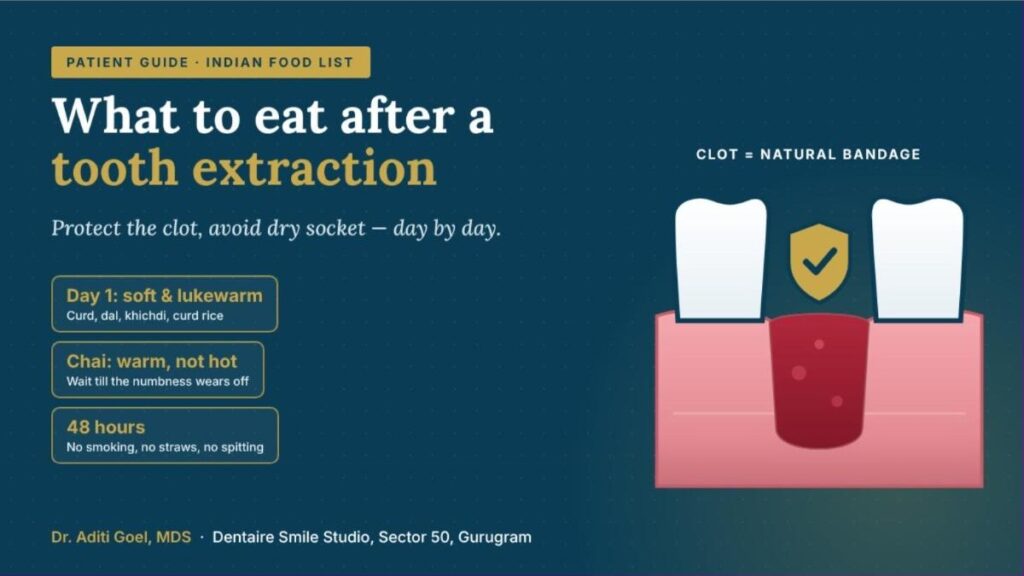
When a tooth comes out, the empty socket fills with blood, and within minutes that blood starts to form a clot. Think of the clot as a natural bandage. It covers the bone and nerve endings at the bottom of the socket, and over the next few days new gum tissue grows in underneath it.
Almost every aftercare rule you’ll hear — no hot food, no straws, no vigorous rinsing, no smoking — is really about one thing: don’t disturb that clot. If it dissolves or is dislodged too early, the bone underneath is exposed and you get dry socket, which is far more painful than the extraction itself.
The good news is that protecting it is easy. You don’t need special recovery foods or expensive supplements. You need soft food, a bit of patience, and to keep the other side of your mouth doing the chewing for a few days.
What to eat after tooth extraction: a day-by-day guide
This is the timeline I give my patients for a routine extraction. If you’ve had a surgical removal — an impacted wisdom tooth, for example — stretch each stage by a day or two and follow your dentist’s specific instructions.
| When | What to eat | What to avoid |
|---|---|---|
| First 2–3 hours (while numb) | Nothing, or just sips of cool water once the gauze is out | Hot drinks and chewing — you can burn or bite your cheek without feeling it |
| Rest of day 1 | Cool or lukewarm soft food: curd, lassi (from a glass, not a straw), dal, khichdi, curd rice, mashed potato, banana, ice cream without nuts | Hot chai and soup, spicy food, anything crunchy, straws, smoking, alcohol |
| Days 2–3 | Add suji upma, soft idli, well-cooked poha, roti soaked in dal, scrambled eggs, paneer bhurji, soft-cooked sabzi, fish | Namkeen, papad, nuts, chikki, popcorn, very spicy or sour food; still no smoking |
| Days 4–7 | Most normal home food, cut small, chewed on the other side | Hard, sticky or very crunchy food on the extraction side |
| After a week | Normal diet for most simple extractions | Anything that still hurts — surgical sites can take longer |
Hospital aftercare leaflets in the UK give very similar advice: wait until the numbness wears off, stick to soft food for the first few days, let hot drinks cool, and leave the area alone for 24 hours (UCLH patient information).
The Indian soft-food list (what’s probably already in your kitchen)
Most “what to eat after tooth extraction” lists online are written for an American kitchen — applesauce, jelly, protein shakes. You don’t need any of that. Indian home food is full of soft, nourishing options:
- Breakfast: suji upma, daliya, soft poha, idli, besan chilla made soft, scrambled eggs, banana, papaya
- Meals: moong dal khichdi, dal-chawal (dal on the thinner side), curd rice, mashed aloo, palak or lauki sabzi cooked soft, paneer bhurji, roti torn small and soaked in dal
- Cooling options for day 1: plain curd, chaas, lassi from a glass, a smoothie eaten with a spoon, plain ice cream or kulfi without nuts
- Sweets (in moderation): kheer or sevaiyan served lukewarm, suji halwa — then brush gently afterwards
Protein matters for healing, so don’t live on ice cream for three days. Dal, curd, eggs and paneer will do far more for the socket than anything sold as a “recovery” product.
Foods to avoid after tooth extraction (and why)
- Hard and crunchy: namkeen, bhujia, papad, chikki, nuts, popcorn, toast. Sharp pieces can poke the clot or lodge in the socket.
- Tiny seeds and husks: til, sesame-topped snacks, popcorn husks. They have a way of ending up exactly where you don’t want them.
- Very spicy or sour food: achaar, green chilli chutney, nimbu. Not dangerous, but they sting an open wound.
- Very hot food and drinks: piping-hot chai, soup straight off the gas. Heat in the first day can make bleeding start again.
- Sticky food: toffees and chewy sweets pull at the area.
- Alcohol: avoid it for at least 24–48 hours; it can slow healing and some aftercare leaflets link it to infection.
- All tobacco — cigarettes, bidis, gutkha, khaini, paan with tobacco: this is the big one, and I’ll explain why below.
Can I drink chai after tooth extraction?
Yes — just not hot, and not immediately. This is the question I’m asked most often in Gurgaon, especially in winter, and the honest answer is gentler than people expect.
Wait until the numbness has completely worn off, usually two to six hours, because you can scald your mouth without feeling it. For the rest of the first day, let your chai cool until it’s comfortably warm rather than steaming, and sip it from the cup rather than swishing it around. From the second day, normal tea is fine. Coffee follows the same rule.
Cold water, by the way, is perfectly fine once the first few hours have passed. If anything, cool drinks are kinder to the area on day one.
The straw question: an honest answer
You’ll read everywhere that a straw “causes” dry socket because the suction pulls the clot out. The truth is that the evidence for this is weaker than the internet suggests — at least one study on wisdom tooth patients found no link between straw use and dry socket. Harvard Health still lists straws as something to avoid, because suction can disturb a fresh clot.
My view is simple: drinking from a glass for three or four days costs you nothing, so why take the chance? Lassi and smoothies taste just as good from a glass or with a spoon.
Dry socket: how common it is, how to spot it, and what to do
Dry socket (alveolar osteitis) happens when the clot is lost before the socket has started to heal, leaving bone exposed. It isn’t an infection and it isn’t dangerous, but it is genuinely painful.
- How common: roughly 0.5–5% of routine extractions, but around 30% of impacted lower wisdom teeth in systematic reviews (StatPearls).
- Smoking more than triples the odds: a 2022 systematic review of 11 studies and over 10,000 patients found dry socket in about 13% of smokers versus about 4% of non-smokers (Dentistry Journal, 2022).
- When it shows up: usually one to five days after the extraction — typically just when the pain should be getting better.
| Normal healing | Possible dry socket |
|---|---|
| Pain is worst in the first 1–3 days, then steadily eases | Pain gets worse around day 2–5 instead of better |
| Discomfort stays around the tooth | Throbbing pain spreads to the ear, eye or neck on that side |
| A dark clot or whitish healing tissue in the socket | The socket looks empty, sometimes with bare bone visible |
| Mild taste for a day or two | A persistent bad taste or bad breath |
| Painkillers keep you comfortable | Over-the-counter painkillers barely help |
If the right-hand column sounds familiar, don’t wait it out — call your dentist. Treatment is quick: the socket is gently cleaned and a soothing medicated dressing is placed, and the pain usually settles within a few days of treatment. Please don’t pack the socket with clove oil, tobacco or home remedies; that just irritates bone that is already exposed. If you need help bridging the time until you can be seen, my guide to toothache relief covers safe painkiller use.
The principle I leave every patient with: the first 48 hours decide how the next two weeks feel.
What to eat after a root canal, filling, implant or cleaning
Extractions are the strictest case. Other treatments are much more relaxed:
- After a root canal: you can eat once the numbness wears off. Until the tooth has its permanent filling or crown, avoid biting hard things on it — a root-canal-treated back tooth is more brittle and can crack. More on what a root canal actually involves and whether you need a crown afterwards.
- After a filling: a tooth-coloured (composite) filling is fully set before you leave the chair, so you can eat as soon as you’re no longer numb. Older silver (amalgam) fillings need about a day before you chew hard on them. See my guide to filling types.
- After a dental implant: soft food for the first several days and no chewing directly on the implant site until your dentist says so — the bone needs time to bond. My implant guide explains the healing stages.
- After teeth cleaning: eat normally. If your teeth feel sensitive, skip very cold drinks for a day or two. Here’s what scaling does and doesn’t do.
Your first-48-hours checklist
- Bite firmly on the gauze for 30–45 minutes after you leave. If bleeding restarts, bite on a fresh rolled gauze or clean handkerchief for another 30 minutes.
- Don’t rinse or spit for 24 hours. Let saliva drain gently; spitting creates suction too.
- From 24 hours, rinse gently with warm salt water (about a teaspoon of salt in a glass of warm water) after meals, for about a week.
- Keep your head raised on an extra pillow the first night, and use a cold pack on the cheek in short spells on day one.
- Brush your other teeth that night, carefully avoiding the socket. A clean mouth heals faster.
- No tobacco and no alcohol for at least 48 hours — longer is better, especially after a wisdom tooth.
- Take painkillers exactly as prescribed, and skip the gym for a day.
- Call your dentist if bleeding hasn’t stopped after an hour of firm pressure, if pain worsens after day two, or if you develop a fever or swelling that keeps growing.
A few Gurgaon-specific tips
Plan around the wedding season. November to February is packed with weddings and functions. If an extraction isn’t urgent, avoid scheduling it a day or two before a big event — rich food, late nights and the temptation of a drink are exactly what a fresh socket doesn’t need.
Office lunches: if you’re back at work in Cyber City or on Golf Course Road the next day, pack curd rice or khichdi rather than relying on the canteen’s tandoori options.
Paan and gutkha: smokeless tobacco is still tobacco. If you use it, an extraction is a good moment to stop — your socket and the rest of your mouth will thank you.
And if you’re still deciding whether a wisdom tooth needs to come out at all, read my wisdom tooth removal guide first — not every one does.
Frequently asked questions
What can I eat after tooth extraction?
Soft, cool or lukewarm food is ideal for the first 24 hours: curd, dal, khichdi, curd rice, mashed potato, banana and plain ice cream. From day two you can add upma, idli, soft poha, eggs, paneer and roti soaked in dal. Chew on the other side and avoid crunchy, spicy and very hot food for a few days.
When can I eat normally after a tooth extraction?
Most people can return to a normal diet after about a week following a simple extraction. Surgical extractions, such as impacted wisdom teeth, can take a little longer. Reintroduce harder foods gradually and keep chewing on the other side until the area feels comfortable.
Can I drink tea after tooth extraction?
Yes, once the numbness has worn off — but keep it warm rather than hot for the first day. Very hot drinks can restart bleeding and you can scald a numb mouth without noticing. From the second day, normal tea and coffee are fine.
Can I eat rice after tooth extraction?
Yes, soft rice is fine, especially as curd rice or khichdi. On the first day, keep it soft and moist so loose grains don’t collect in the socket, and chew on the other side. If a grain does get stuck, don’t dig at it — from 24 hours, a gentle warm salt-water rinse will usually clear it.
Can I drink cold water after tooth extraction?
Yes. Cool or cold water is fine once the first couple of hours have passed and the gauze is out. Just sip it rather than swishing it around the socket on the first day.
What is dry socket and how do I know if I have it?
Dry socket is when the blood clot is lost from the socket before it heals, exposing the bone. The giveaway is pain that gets worse two to five days after the extraction instead of better, often spreading to the ear, with a bad taste or an empty-looking socket. It affects roughly 0.5–5% of routine extractions and more after lower wisdom teeth. A dentist can clean the socket and place a soothing dressing.
How long after tooth extraction can I use a straw?
It’s sensible to avoid straws for the first three or four days. The evidence that straws cause dry socket is weaker than often claimed, but the suction can disturb a fresh clot, and drinking from a glass costs you nothing.
What should I eat after a root canal?
You can eat normally once the numbness wears off, but avoid biting hard foods on the treated tooth until it has its permanent filling or crown. Root-canal-treated back teeth are more brittle and can crack under heavy chewing.
How much does tooth extraction cost in Gurgaon?
In Gurgaon in 2026, a simple extraction of a fully erupted wisdom tooth typically costs ₹2,000–₹4,000, while surgical removal of an impacted wisdom tooth ranges from about ₹4,000 to ₹15,000 depending on how deep it is. An X-ray assessment comes first, because the exact cost depends on the tooth’s position. Our wisdom tooth cost guide breaks this down.
An extraction is one of the most routine things we do, and for most people recovery is uneventful. Soft food, no tobacco, a little patience with your chai — and if the pain turns the wrong way after day two, a quick visit rather than a brave week of suffering.
Dentaire Smile Studio is at A127, Nirvana Courtyard Market, Nirvana Country, Sector 50, Gurugram.
Open Monday – Saturday, 10 AM – 7:30 PM.
📞 +91 9315158145 | 🌐 dentaire.in
Dr. Aditi Goel, MDS (Conservative Dentistry & Endodontics), practises at Dentaire Smile Studio, Sector 50, Gurugram, where she focuses on saving natural teeth with conservative and microscope-assisted treatment.
 हिन्दी
 English