
By Dr. Aditi Goel, MDS — Conservative Dentistry Expert, Dentaire Smile Studio, Sector 50, Gurugram
Published: November 2026 | 10-minute read
It’s Diwali week. The mithai boxes have started arriving, and you bite into a piece of soan papdi. A sharp twinge shoots through a back tooth and then fades. Later, you run your tongue over the spot and feel something rough, maybe a tiny hole. In the mirror there’s a dark speck you’re sure wasn’t there before. Is that a cavity? Does it need a filling? And why did one clinic say ₹800 and another ₹3,000?
If that sounds familiar, you’re in good company. Fillings are the treatment I do most often, and the questions are always the same: which type, how much, and does it really need to be done now? Here are honest answers, including when you don’t need a filling at all.
What a filling actually does
A tooth has a hard outer shell of enamel and, underneath it, a softer layer called dentine that surrounds the nerve. Decay starts when bacteria in plaque turn sugar into acid, and that acid slowly dissolves the enamel.
At first, the damage is only a weak, chalky patch on the surface. Once the acid breaks through the enamel into the dentine, decay spreads much faster, because dentine is softer. That’s the point where a tooth needs a filling: the decayed part is removed and the space is sealed with a material that restores the shape and stops bacteria getting back in.
A filling doesn’t make the tooth stronger than it was. It replaces what has been lost. That’s why the size of the cavity, not the brand of material, is the biggest factor in how long your tooth lasts.
Not every dark spot needs a filling
This is the part of the conversation that surprises patients most. A few situations where I usually don’t drill:
1. Stains in the grooves. Chai, coffee and paan can leave brown or black lines in the grooves of back teeth. If the surface is hard and the X-ray is clear, it’s a stain, not a cavity. Polishing is enough.
2. Early white-spot lesions. A chalky white patch, often near the gum line or around old braces, is the very first stage of decay. At this stage the enamel can still remineralise. Fluoride, better brushing and cutting down how often you eat sugar can stop it, and we simply watch it at your next check-up.
3. Old fillings that are doing their job. A slightly discoloured filling with a sealed edge and no decay underneath doesn’t need replacing. Every time a filling is replaced, a little more healthy tooth is lost, and the cavity gets bigger.
4. Wear at the gum line that isn’t sensitive. Small notches near the gum, often from brushing too hard, don’t always need filling. If they’re sensitive, deepening or catching food, a filling helps. If not, changing your brushing technique may be enough.
The principle I follow is simple:
Fill what is decayed. Watch what is early. Leave alone what is healthy.
If you’ve been told you need several fillings at once, it’s fair to ask to see the X-ray or an intraoral photo of each tooth. A good dentist will show you exactly what they see.
Signs you may need a filling
- A twinge when you eat something sweet, or sip something cold
- Food repeatedly getting stuck between the same two teeth
- A rough edge, a hole, or a sharp corner you can feel with your tongue
- A dark spot that is getting bigger, or a chalky patch that has turned brown
- A piece of an old filling or a corner of a tooth breaking off
The tricky part is that cavities between teeth often cause no symptoms until they’re large. They show up on a small X-ray long before you can feel them. That’s the main reason I recommend a check-up every six months, even when nothing hurts.
Types of fillings: an honest comparison
These are the options you’ll be offered at most Gurgaon clinics:
| Composite (tooth-coloured) | GIC (glass ionomer) | Silver amalgam | Ceramic inlay / onlay | |
|---|---|---|---|---|
| Appearance | ✅ Matches the tooth | ⚠️ Tooth-coloured but more opaque | ❌ Silver, darkens over time | ✅ Very natural |
| Best for | Most small and medium cavities, front and back | Gum-line cavities, milk teeth, temporary or interim fillings | Large back-tooth fillings (now used less) | Large cavities or broken cusps |
| Strength under chewing | ✅ Good | ⚠️ Lower, wears faster | ✅ Good | ✅ Very good |
| Bonds to the tooth | ✅ Yes | ✅ Yes, and releases fluoride | ❌ No, held in by shape | ✅ Yes |
| Healthy tooth removed | ✅ Minimal | ✅ Minimal | ⚠️ More, to create a locking shape | ⚠️ Moderate |
| Visits | ✅ One | ✅ One | ✅ One | ⚠️ Usually two |
| Cost | ✅ Low | ✅ Lowest | ✅ Low | ⚠️ High |
Composite is the filling most people get today. It’s bonded to the tooth in thin layers and set hard with a blue light, so very little healthy tooth needs to be removed. A large review of back-tooth composites in the Journal of Dental Research (Opdam and colleagues, 2014) found an average failure rate of about 2.4% a year over ten years, which means most were still working a decade later. In people who got new cavities often, the failure rate was almost double, mainly from fresh decay and fractures.
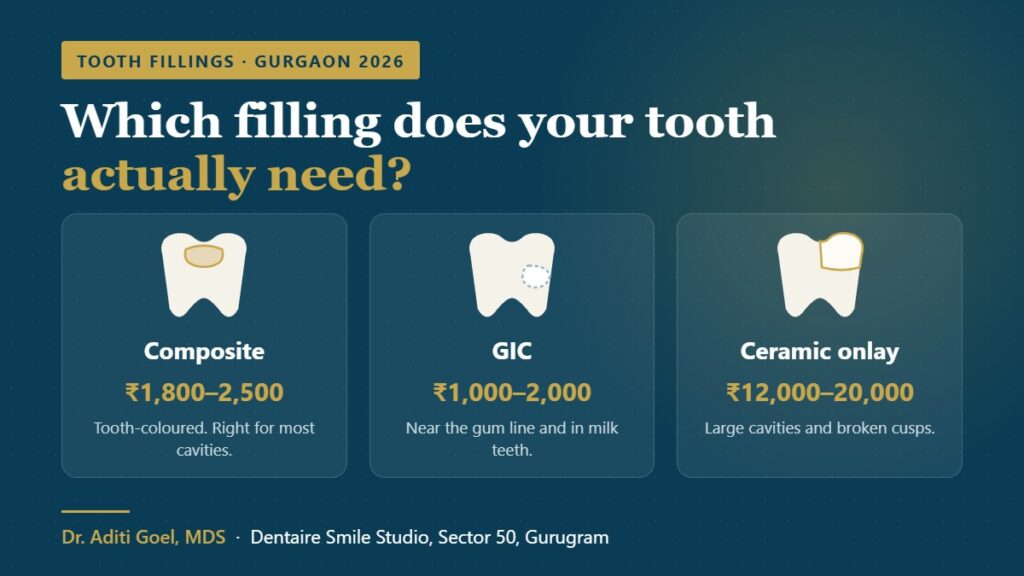
GIC (glass ionomer) is softer and wears faster on biting surfaces, but it bonds chemically to the tooth and slowly releases fluoride. I use it for cavities near the gum line, for children’s milk teeth, and as an interim filling while we decide on a longer-term plan.
Ceramic inlays and onlays are made in a lab and bonded in. When a cavity is so large that a filling would leave thin, weak walls, an onlay protects the tooth without the trimming a full crown needs. I’ve explained when this makes sense in my article Do you really need a crown?
What about old silver fillings?
Silver fillings, or dental amalgam, contain mercury bound with silver, tin and copper. They’ve been used for over a century and many adults in India still have several.
In November 2025, countries that are party to the Minamata Convention on Mercury agreed in Geneva to phase out dental amalgam by 2034. India was among the countries that argued against an earlier 2030 deadline. The phase-out is mainly about mercury pollution from manufacturing and disposal.
What it does not mean is that you need to rush to replace intact silver fillings. Drilling out a sound filling removes healthy tooth as well. I recommend replacing an amalgam filling only when:
- It is cracked, chipped or has a gap at the edge
- There is new decay around or under it
- The tooth around it has cracked or a cusp has broken
- It’s in a visible area and its appearance genuinely bothers you
Large old silver fillings are a common reason teeth crack, so if you have several, it’s worth having them checked. Checking is not the same as replacing.
Tooth filling cost in Gurgaon (2026)
Here’s what fillings typically cost per tooth. The range depends mainly on the size of the cavity, which tooth it is, and whether the decay is close to the nerve.
| Type | Typical range in Gurgaon (per tooth) | At Dentaire Smile Studio |
|---|---|---|
| Composite (tooth-coloured) | about ₹1,000 – ₹3,000 | usually ₹1,800 – ₹2,500 |
| GIC (glass ionomer) | about ₹1,000 – ₹2,000 | usually ₹1,000 – ₹2,000 |
| Large composite build-up, e.g. a broken front tooth | ₹2,500 – ₹3,000+ | up to about ₹3,000 |
| Temporary filling | ₹500 – ₹1,000 | about ₹500 |
| Ceramic inlay / onlay | usually close to an E-max crown | ₹12,000 – ₹20,000 |
| Check-up and consultation | varies by clinic | ₹500 |
Some large chains in Gurgaon advertise composite fillings from under ₹1,000. Starting prices usually apply to the smallest cavities, so ask what your tooth will cost once it has been examined.
What a complete quote should include: the examination, any X-ray needed to check depth, local anaesthesia, removal of decay, the filling itself, and bite adjustment and polishing. If the cavity is deep, ask whether a protective liner is included, and what happens if the nerve turns out to be involved.
The real cost of waiting
This is the table I wish every patient saw before deciding to “wait and see” with a cavity that’s already through the enamel:
| Stage | What’s needed | Typical cost in Gurgaon (2026) |
|---|---|---|
| Early white spot | Fluoride and better habits | Usually just the check-up |
| Small or medium cavity | A filling | ₹1,800 – ₹2,500 |
| Decay reaches the nerve | Root canal treatment + crown | ₹7,000 – ₹12,000 for the root canal, plus ₹4,000 – ₹18,000 for the crown |
| Tooth can’t be saved | Extraction + implant with crown | ₹28,000 – ₹75,000 |
A small filling is one of the least expensive treatments in dentistry. Delaying it is one of the most expensive decisions.
What happens during a filling
- Check and X-ray. I look at the tooth and, if needed, take a small X-ray to see how deep the decay goes.
- Numbing. Most fillings are done under local anaesthesia. Very small, shallow cavities sometimes don’t need it.
- Removing the decay. Only the soft, decayed tooth is removed. For deep cavities close to the nerve, I work under the dental operating microscope, which makes it easier to remove all the decay while keeping as much healthy tooth as possible.
- Bonding and filling. The tooth is kept dry, the bonding agent is applied, and the composite is placed in thin layers, each set hard with a light.
- Shaping and checking the bite. The filling is shaped and polished, and we check that your bite feels normal.
Most single fillings are done in one visit. Mild sensitivity to cold for a few days is normal. If the tooth hurts on biting after the numbness wears off, the filling may be slightly high, and a quick adjustment fixes it.
If a cavity turns out to have reached the nerve, a filling alone won’t be enough. My page on root canal treatment in Gurgaon explains what happens next.
Why cavities are so common in India
A meta-analysis in the Journal of Clinical and Diagnostic Research (2018) estimated that around 78% of Indian adults aged 35–44 have had dental caries, and around half of 5- and 12-year-olds. In Gurgaon, I see the same patterns behind most of the cavities I fill:
How often, not how much. Three cups of sweet chai spread through the workday, a biscuit with each, and mithai after dinner keep your teeth under acid attack for hours. Your mouth needs time between snacks to recover.
Sticky sweets. Festive favourites like soan papdi, gajak and chikki cling to the grooves of back teeth and between them, especially around old fillings.
Waiting for pain. Many of us only see a dentist once a tooth hurts. By then, a small filling has often become a root canal.
Children’s teeth. Milk teeth have thinner enamel, so decay spreads faster. A cavity in a milk tooth still needs attention, because the tooth holds space for the adult tooth underneath. My guide to your child’s first dental visit covers this.
Protecting your teeth this Diwali
- Eat sweets with a meal, not as a snack. One sitting does far less damage than nibbling all evening.
- Rinse with water after mithai or chai. It washes away sugar and helps your saliva bring the acid level back down.
- Wait 30–60 minutes before brushing after something acidic, like lime soda or fruit juice, so you’re not brushing softened enamel.
- Brush twice a day with a fluoride toothpaste, and clean between your teeth with floss or interdental brushes.
- Don’t crack nuts or supari with your teeth, especially on teeth with large fillings.
- If a tooth starts twinging with sweets, book a check-up. Catching a cavity at the filling stage saves the tooth, and a lot of money.
If a tooth is already aching, my guide on what to do for a toothache covers safe short-term relief. And if your teeth are sensitive rather than painful, start with my guide to sensitive teeth.
Frequently Asked Questions
Q: How much does a tooth filling cost in Gurgaon?
A: In 2026, a tooth-coloured composite filling in Gurgaon typically costs about ₹1,000–₹3,000 per tooth, and a GIC (glass ionomer) filling about ₹1,000–₹2,000. At Dentaire Smile Studio, most composite fillings are ₹1,800–₹2,500 per tooth. Ceramic inlays and onlays for large cavities cost much more, usually close to an E-max crown (₹12,000–₹20,000).
Q: Which filling is best for a back tooth?
A: For most back teeth, a bonded composite filling is a good choice for small and medium cavities. If the cavity is large or a cusp has broken, a ceramic onlay protects the tooth better. GIC is useful near the gum line, in milk teeth and as a temporary or interim filling, but it wears faster under heavy chewing.
Q: Is getting a tooth filling painful?
A: Most fillings are done under local anaesthesia, so you feel pressure and vibration rather than pain. Very small cavities sometimes don’t need anaesthesia at all. It’s normal for the tooth to feel a little sensitive to cold for a few days afterwards.
Q: How long does a composite filling last?
A: A well-placed composite filling in a back tooth usually lasts many years. A large review of posterior composites found an average failure rate of about 2.4% a year over ten years, so most were still working a decade later. Large fillings, grinding and frequent new cavities shorten their life.
Q: Can a cavity heal on its own?
A: An early cavity that is still only in the enamel, often seen as a chalky white spot, can sometimes be stopped or reversed with fluoride, better brushing and less frequent sugar. Once decay has broken through the enamel into the dentine, it cannot heal and needs a filling.
Q: Should I replace my old silver fillings?
A: Not if they are intact and there is no decay around them. Removing a sound amalgam filling removes healthy tooth too. Replace a silver filling if it is cracked, leaking, has decay underneath, or the tooth around it is breaking.
Q: Are silver amalgam fillings being banned?
A: Countries that are party to the Minamata Convention on Mercury, including India, agreed in November 2025 to phase out dental amalgam by 2034. This is mainly about mercury pollution; it does not mean existing intact fillings must be removed.
Q: How do I know if I need a filling?
A: Common signs are sensitivity to sweets or cold, food getting stuck between two teeth, a rough edge or hole you can feel with your tongue, or a dark spot that is getting bigger. Many cavities between teeth cause no symptoms at all and only show on an X-ray, which is why regular check-ups matter.
Q: Can I eat after a tooth filling?
A: After a composite filling you can eat once the numbness wears off, because the filling is set hard with a light before you leave. Avoid chewing on the numb side so you don’t bite your cheek or tongue. With GIC, avoid hard or sticky food on that tooth for the first day.
Q: What happens if I don’t fill a cavity?
A: The decay keeps spreading towards the nerve. A cavity that needs a ₹2,000 filling today can become a root canal and a crown, costing ₹11,000–₹30,000, or an extraction and implant later. Decay rarely stops on its own once it reaches the dentine.
The bottom line
A filling is small, quick and affordable when it’s done at the right time. Not every dark spot needs one, and not every old filling needs replacing. But a cavity that has broken through the enamel won’t wait for you, and the longer it waits, the bigger and more expensive the repair.
If you’ve noticed a twinge, a rough edge or a dark spot, or you’ve been told you need several fillings and want a second opinion, I’m happy to take a look. I’ll show you what I see on the tooth and the X-ray, and explain every option, including when it’s fine to wait.
Dentaire Smile Studio is at A127, Nirvana Courtyard Market, Nirvana Country, Sector 50, Gurugram.
Open Monday – Saturday, 10 AM – 7:30 PM.
📞 +91 9315158145 | 🌐 dentaire.in
Dr. Aditi Goel (MDS) is a microscopic endodontics specialist and conservative dentist, and the founder of Dentaire Smile Studio in Sector 50, Gurugram. She focuses on saving natural teeth wherever possible.
 हिन्दी
 English