
By Dr. Aditi Goel, MDS — Conservative Dentistry & Endodontics, Dentaire Smile Studio, Sector 50, Gurugram
Published: November 2026 | 10-minute read
You spit after brushing and there’s pink in the sink again. Your gums look a little puffy, one lower tooth feels slightly loose when you bite into a guava, and your mother has already told you what it is: “Pyorrhea hai. Namak aur sarson ka tel lagao.”
If that sounds familiar, you’re in very large company. Pyorrhea is one of the most common reasons adults in India lose teeth, and also one of the most misunderstood. People are told it’s incurable, or that a special toothpaste will fix it, or that loose teeth simply come with age. None of that is quite true.
In this guide I’ll explain what pyorrhea actually is, how to tell where you are on the scale from early gum inflammation to advanced disease, what treatment can and can’t do, what it costs in Gurgaon in 2026, and which home remedies are worth your time.
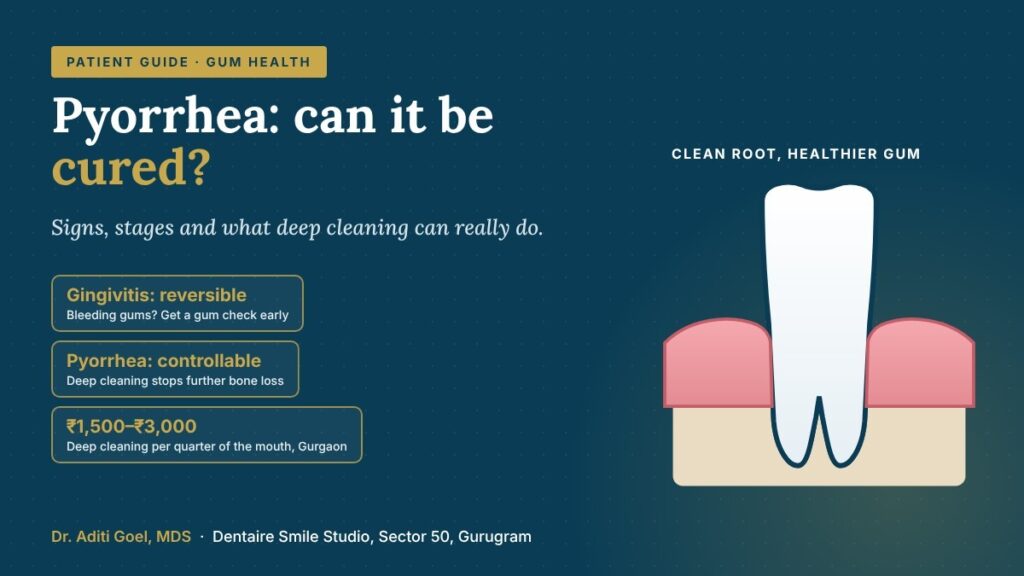
Quick answer: Pyorrhea is the old Indian name for periodontitis, a bacterial infection that destroys the gum and bone holding your teeth. Early gum disease (gingivitis) is fully reversible. Pyorrhea can’t be undone, but it can be stopped and controlled with deep cleaning (scaling and root planing), better home care and regular maintenance. In Gurgaon, deep cleaning typically costs ₹1,500–₹3,000 per quarter of the mouth.
What is pyorrhea, really?
The word comes from Greek: pyo (pus) and rrhoea (flow). Older generations used it for the stage where gums bleed, swell and sometimes ooze pus. Dentists today call it periodontitis.
Here’s what is happening underneath. Plaque, the soft film of bacteria on your teeth, hardens into tartar (calculus) within days if it isn’t removed. Tartar along and below the gum line irritates the gum, which pulls away from the tooth and forms a small gap called a pocket. Bacteria thrive in that pocket. Your body’s own inflammatory response, trying to fight them, slowly breaks down the bone that anchors the tooth.
The key thing to understand: bone lost to pyorrhea doesn’t grow back on its own. That’s why the goal of treatment is to stop the process early, while you still have plenty of support left.
Pyorrhea symptoms: the signs most people ignore
- Bleeding gums when you brush, floss or bite into an apple. Healthy gums don’t bleed.
- Swollen, red or tender gums instead of firm, pale pink ones.
- Bad breath or a bad taste that comes back soon after brushing. See my guide to bad breath causes.
- Receding gums, so teeth look longer or gaps appear between them.
- Pus along the gum line when you press it.
- Loose or shifting teeth, or a change in how your teeth meet when you bite.
- Sensitivity to cold as roots become exposed.
The trouble is that pyorrhea rarely hurts until it’s advanced. Many of my patients only come in when a tooth has become loose, and by then a lot of the supporting bone may already be gone.
Gingivitis vs pyorrhea: which one do you have?
These are two stages of the same disease, and the difference matters because one is fully reversible and the other isn’t.
| Gingivitis (early gum disease) | Pyorrhea (periodontitis) | |
|---|---|---|
| What’s affected | Gums only | Gums, ligament and bone |
| Bleeding | Yes, on brushing | Yes, often with swelling or pus |
| Pockets | None or shallow | Deeper pockets around teeth |
| Bone loss on X-ray | No | Yes |
| Loose teeth | No | Possible in later stages |
| Reversible? | ✅ Fully, with cleaning and good brushing | ⚠️ Can be stopped and controlled; lost bone usually doesn’t return |
| Typical treatment | Scaling and polishing + home care | Deep cleaning (scaling and root planing), maintenance, sometimes surgery |
Only an examination with a gum probe and an X-ray can tell you which stage you’re at. Bleeding alone doesn’t tell you; it’s present in both.
The four stages of periodontitis
In 2017 the international periodontal societies agreed a new classification that grades periodontitis in four stages, based on how much attachment and bone has been lost and how complex the case is (Tonetti, Greenwell & Kornman, 2018). In plain language:
| Stage | What it means | What it usually needs |
|---|---|---|
| Stage I – initial | Early attachment loss, shallow pockets, minimal bone loss | Deep cleaning and better home care |
| Stage II – moderate | More bone loss, pockets getting deeper, no teeth lost to gum disease | Deep cleaning, re-evaluation, regular maintenance |
| Stage III – severe | Bone loss into the middle third of the root; some teeth may already be lost | Deep cleaning, then often gum surgery for deep pockets |
| Stage IV – advanced | Severe bone loss, shifting teeth, problems chewing | Comprehensive treatment, sometimes extractions and replacement |
The same framework also grades how fast the disease is progressing. Smoking and poorly controlled diabetes are the two big factors that push someone into a faster-progressing grade.
Is pyorrhea curable? The honest answer
This is the question I’m asked most, and I’d rather give you the honest version than the reassuring one.
Pyorrhea can be stopped, but it can’t be reversed. Once bone has been lost, deep cleaning won’t regrow it. What treatment does very well is remove the bacteria and tartar driving the disease, let the gums heal and tighten around the teeth, and stop further bone loss. Many patients keep their teeth for decades this way.
The research is realistic about this. A 2015 systematic review for the American Dental Association found that scaling and root planing improves gum attachment by about 0.5 mm on average (moderate-certainty evidence) (Smiley et al., JADA 2015). That sounds small, but in a disease that only moves in one direction, stopping it and gaining back a little is a real win.
Think of pyorrhea like diabetes or blood pressure: it’s managed, not cured once and forgotten. The principle I give every patient: gingivitis is a warning; pyorrhea is a responsibility.
How pyorrhea is treated, step by step
- Assessment. A full gum examination, measuring the pocket around every tooth, plus digital X-rays to see the bone levels.
- Scaling and root planing (deep cleaning). Under local anaesthetic, tartar and infected deposits are removed from the root surfaces below the gum line, usually one quarter of the mouth at a time. It’s very different from a routine scaling and polishing, which only cleans above the gum line.
- Home-care coaching. Brushing technique, interdental brushes or floss, and sometimes a short course of a prescribed mouthwash. This part decides whether treatment lasts.
- Re-evaluation after 6–8 weeks. We measure the pockets again. Many shrink enough that nothing more is needed.
- Surgery, only if needed. Deep pockets that don’t respond may need flap surgery or regenerative procedures.
- Maintenance. A professional clean every 3–6 months, depending on how active your disease was.
Antibiotics alone don’t cure pyorrhea. They can help in specific cases alongside deep cleaning, but tartar stuck to the root has to be physically removed. Be cautious of anyone offering a “one-sitting pyorrhea cure” or laser as a substitute for cleaning.
Pyorrhea treatment cost in Gurgaon (2026)
These are the 2026 Gurgaon ranges we publish on our gum treatment page. Your exact cost depends on how many areas need treatment, which we can only tell after an examination.
| Treatment | Typical range in Gurgaon | Notes |
|---|---|---|
| Check-up and examination at Dentaire Smile Studio | ₹500 | Includes a basic gum check |
| Full periodontal (gum) assessment | ₹500 – ₹800 | Pocket charting for every tooth |
| Professional cleaning (scaling and polishing) | ₹1,800 – ₹2,500 | For gingivitis or maintenance visits |
| Deep cleaning – scaling and root planing | ₹1,500 – ₹3,000 per quarter of the mouth | Full mouth usually done over 2 visits |
| Gum surgery or grafting | Quoted after assessment | Only for pockets that don’t respond to cleaning |
Two honest notes. First, a very cheap “pyorrhea package” that is really just a quick polish won’t touch tartar below the gum line, so the disease keeps going. Second, the most expensive outcome is waiting: replacing a lost tooth with a dental implant costs far more than keeping the one you have.
Pyorrhea home remedies: what helps and what doesn’t
I understand the appeal of home remedies, and some have a place. But none of them can remove hardened tartar from under the gum, which is the actual cause.
| Remedy | Verdict |
|---|---|
| Salt and mustard oil gum massage | ⚠️ May soothe gums briefly; doesn’t remove tartar or treat pockets |
| Warm salt-water rinse | ⚠️ Comforting for sore gums; not a treatment |
| Oil pulling (coconut or sesame) | ⚠️ A 2022 meta-analysis of 9 trials found less saliva bacteria but no significant change in plaque or gum inflammation (Peng et al., 2022) |
| Neem datun | ⚠️ Fine for cleaning, but can’t reach below the gum line |
| “Anti-pyorrhea” toothpaste | ⚠️ Any fluoride toothpaste used well helps control plaque; no paste dissolves tartar under the gum |
| Brushing twice + interdental cleaning | ✅ Essential, especially after professional treatment |
| Stopping smoking, gutkha and khaini | ✅ One of the most powerful things you can do |
| Getting diabetes under control | ✅ Directly improves how gums heal |
Why pyorrhea is so common in India
A 2020 systematic review of Indian studies estimated that about half of Indian adults (51%) have periodontal disease (Journal of Oral Biology and Craniofacial Research, 2020). In my practice in Gurgaon, a few patterns come up again and again:
- We wait for pain. Gum disease rarely hurts, so routine cleanings get skipped for years.
- Tobacco in every form. Cigarettes, bidis, gutkha and khaini all reduce blood supply to the gums and hide bleeding, so the disease advances quietly.
- Diabetes. India’s high rate of diabetes and gum disease feed each other. I’ve written about that link, and the heart connection, in this guide.
- Hard-to-clean spaces. Crowded teeth and old fillings with overhangs trap plaque that a brush can’t reach.
What you can do this week
- Look for bleeding when you brush. If it happens more than occasionally, book a gum check rather than switching toothpastes.
- Brush twice a day for two minutes with a soft brush, angled towards the gum line.
- Clean between your teeth once a day with floss or interdental brushes.
- If you smoke or use gutkha, this is the strongest reason to stop.
- If you’re diabetic, mention it at your dental visit and keep your sugars in range.
- Get a professional teeth cleaning at least once a year, more often if you’ve had gum disease.
Frequently asked questions
Is pyorrhea curable?
Pyorrhea (periodontitis) can be stopped and controlled, but bone that has already been lost usually doesn’t grow back. With deep cleaning, good home care and regular maintenance visits, most people can keep their teeth for many years. Early gum disease (gingivitis) is fully reversible.
What are the first signs of pyorrhea?
The earliest signs are gums that bleed when you brush, gums that look red or swollen, and bad breath that keeps coming back. Later signs include receding gums, pus around the teeth and teeth that feel loose.
Can pyorrhea be cured at home?
No. Home care such as brushing, cleaning between the teeth and salt-water rinses helps control plaque and is essential after treatment, but no home remedy can remove hardened tartar from under the gum line. That needs professional deep cleaning.
How much does pyorrhea treatment cost in Gurgaon?
In Gurgaon in 2026, a full gum assessment typically costs ₹500–₹800, professional cleaning ₹1,800–₹2,500 and deep cleaning (scaling and root planing) ₹1,500–₹3,000 per quarter of the mouth. Gum surgery, if needed, is quoted after assessment.
Is deep cleaning for pyorrhea painful?
Deep cleaning is done under local anaesthetic, so most people feel pressure and vibration rather than pain. The gums can feel tender for a day or two afterwards, and teeth may be a little sensitive to cold for a short while.
Can loose teeth from pyorrhea become tight again?
Teeth that are slightly loose often firm up once the infection is controlled and the gums heal. Teeth with very little bone support left may stay mobile, and some may need splinting or, in advanced cases, removal.
Which toothpaste is good for pyorrhea?
Any fluoride toothpaste used well with a soft brush helps control plaque. Toothpastes sold for gum problems can help with mild bleeding, but no toothpaste can dissolve tartar below the gum line or treat periodontal pockets.
Does pyorrhea spread from one tooth to others?
The bacteria involved are present throughout the mouth, so if one area has pyorrhea, others are often affected too. That’s why a full-mouth gum assessment is important rather than treating a single tooth.
Can pyorrhea come back after treatment?
Yes, if plaque is allowed to build up again. Regular maintenance cleanings every 3 to 6 months, daily cleaning between the teeth and avoiding tobacco greatly reduce the chance of it returning.
Is pyorrhea linked to diabetes and heart disease?
Yes. Diabetes makes gum disease worse and gum disease can make blood sugar harder to control. Research also links periodontitis with heart disease, though it doesn’t prove one causes the other.
Pyorrhea is common, quiet and very treatable when it’s caught early. If your gums bleed, don’t wait for a tooth to become loose. A gum check takes a few minutes and tells you exactly where you stand.
Dentaire Smile Studio is at A127, Nirvana Courtyard Market, Nirvana Country, Sector 50, Gurugram.
Open Monday – Saturday, 10 AM – 7:30 PM.
📞 +91 9315158145 | 🌐 dentaire.in
Dr. Aditi Goel, MDS (Conservative Dentistry & Endodontics), practises at Dentaire Smile Studio, Sector 50, Gurugram, where she focuses on saving natural teeth with conservative and microscope-assisted treatment.
 English
 हिन्दी